
Amazing food with a side of culture. That sums up Italy, and in less than 140 characters. The side of culture comes in different flavors, staying with an Italian family, getting pickpocketed, or eating dinner over a labyrinth of tunnels dug out in 300 BC. Now, now you’ve got Orvieto in Umbria.
It takes some work to get to Orvieto still today. But I guess that’s the way it was planned to be. Usually I meet my mother in Roma Termini to take a fast train to Firenze, or further north. This time we booked our train tickets to Orvieto online while on the Leonardo Express on our way from the airport to Roma Termini, leaving 20 minutes in between trains.
We arrived at Binario 24. We had to get to Binario 1EST. With luggage.
What? I thought. How many times have I been through Roma Termini, even on this trip already, and I’ve never seen “EST” designating a platform? Does that mean “estimated” track? That’s not even Italian, I laughed at myself.
“Nel fondo,” the woman at the information desk said. I’m not always sure of what I’ve heard, but I followed what I thought she meant, in the back.
OK, I thought. And where is that exactly?
We Olympic style walked past the platforms, in decreasing number, because that seemed to be the right direction, and at the end, at Binario 1, took a right turn to go to the back. The uncomfortable part was rushing my mother along somewhere to find out the train was somewhere else.
I stopped and asked a man in a safety vest and hard hat if he knew where Binario 1EST was. Same response.
“Nel fondo.”
When I looked like I didn’t understand where that was, he found another way to express his instructions in Italian, “Just go until the end of the track.”
I gave it all up to fate. There would be another train to Orvieto. But a stationary train came into view, ours, and once I had a target, I picked up the pace to make sure one of us reached the train before it started to roll. We had left the main crowd at the regular platforms, making it easier to navigate the station, and made it with five minutes to spare.
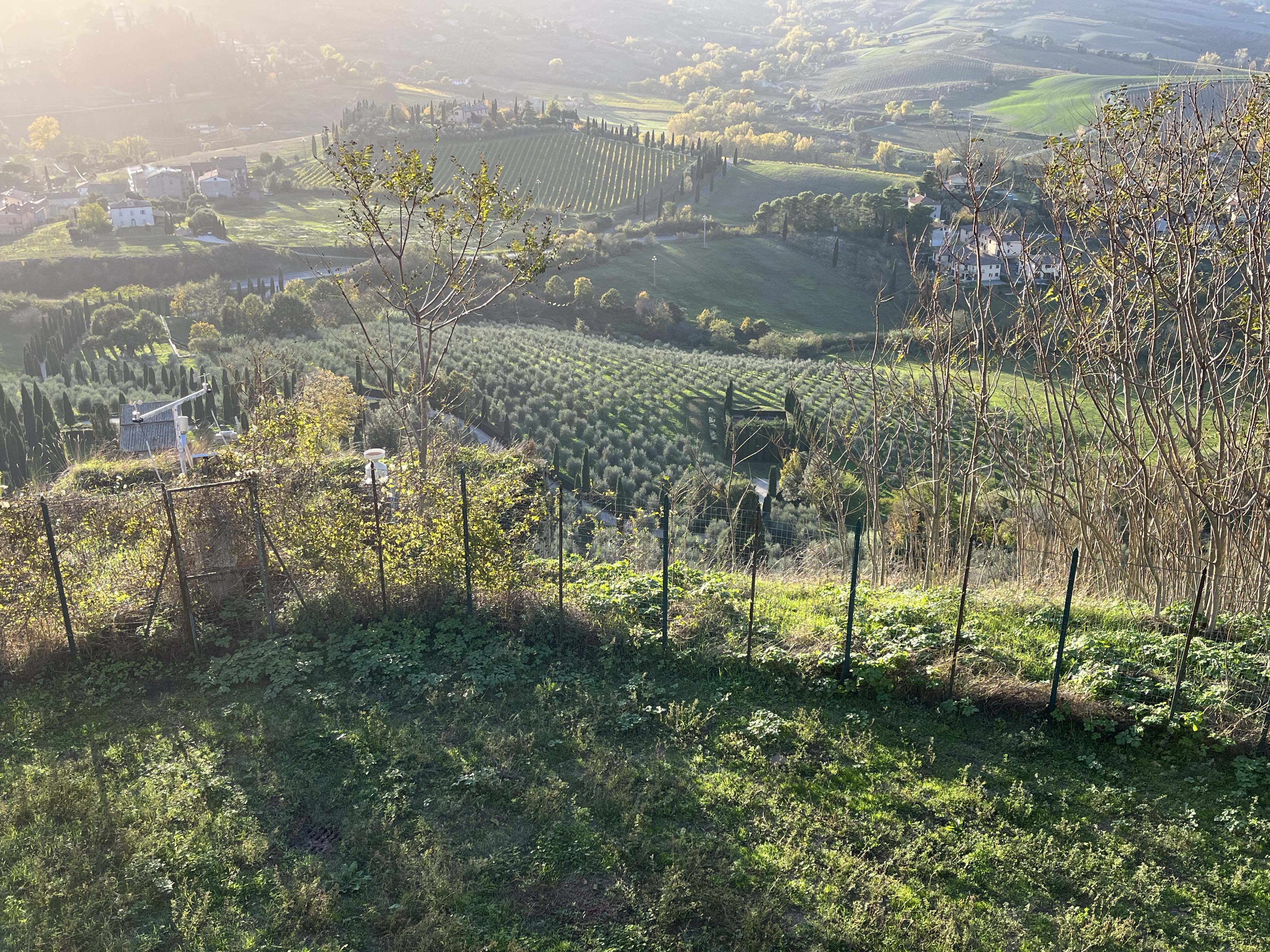
The train to Orvieto was another species, from another time, rolling through the artwork of the fields that were still green. Not the upscale fast train, with reserved seats, from Roma to Firenze. After a little over an hour, we disembarked at Orvieto, the new town in the valley. Our train ticket included a bus ride up to the central station at the top in the hill town, although I’m not sure we needed to pay for that bus ride, or the one that took us close to our hotel. The drivers didn’t check for tickets.
The smaller hill town Bus A took us close to our hotel, dropping us off at a corner in the middle of a thoroughfare for the little traffic that did pass through Orvieto. We were trapped at the corner by a continuous stream of cars; none would stop for us. About as bad as Napoli. You just have to go.
We finally made a break for it, crossing onto the narrow street that opened up in the Piazza del Popolo.
“Where is the Grand Hotel?” I asked the first person we met in the piazza.
“Grand Hotel Italia?” he asked, smiling. “It’s right in front of you.”
The last obstacle appeared in the form of a short staircase up to our room at the top of the hotel, which according to one of America’s most revered travel experts is not worth the money, which according to my mother means, “That person is just cheap.”
“The best room,” Maurizio, the man at the reception desk, said. “That’s what your mother asked for.”
And it was. Our room had two terraces, one large with sun in the afternoon and one small with a view of the rooftops, the terra cotta tiles of which used to be molded over the thighs of the workers.
Yeah, travel is all about the journey.
“Why didn’t you take a car?” a friend in Germany said. I wasn’t up for that kind of entertainment. Trying to determine which streets I could drive on, in which direction, in a hill town I didn’t know. Or if I could even bring a car up there at all.
The thick fog in the mornings further separated our piece of heaven, derived from Urbus Vetrus meaning old city in Latin, from earth.
Maurizio had time to gab, chiacchierare, in the shoulder season. I forgot that restaurants open later in the evening in Italy (19:30), which I thought meant everyone was on holiday, and the best restaurants would be closed.
“Don’t worry,” Maurizio said. “There are restaurants every few meters in Orvieto.”
He was right about that. You can pretty much confess your sins every few meters in the town too. Churches are everywhere.
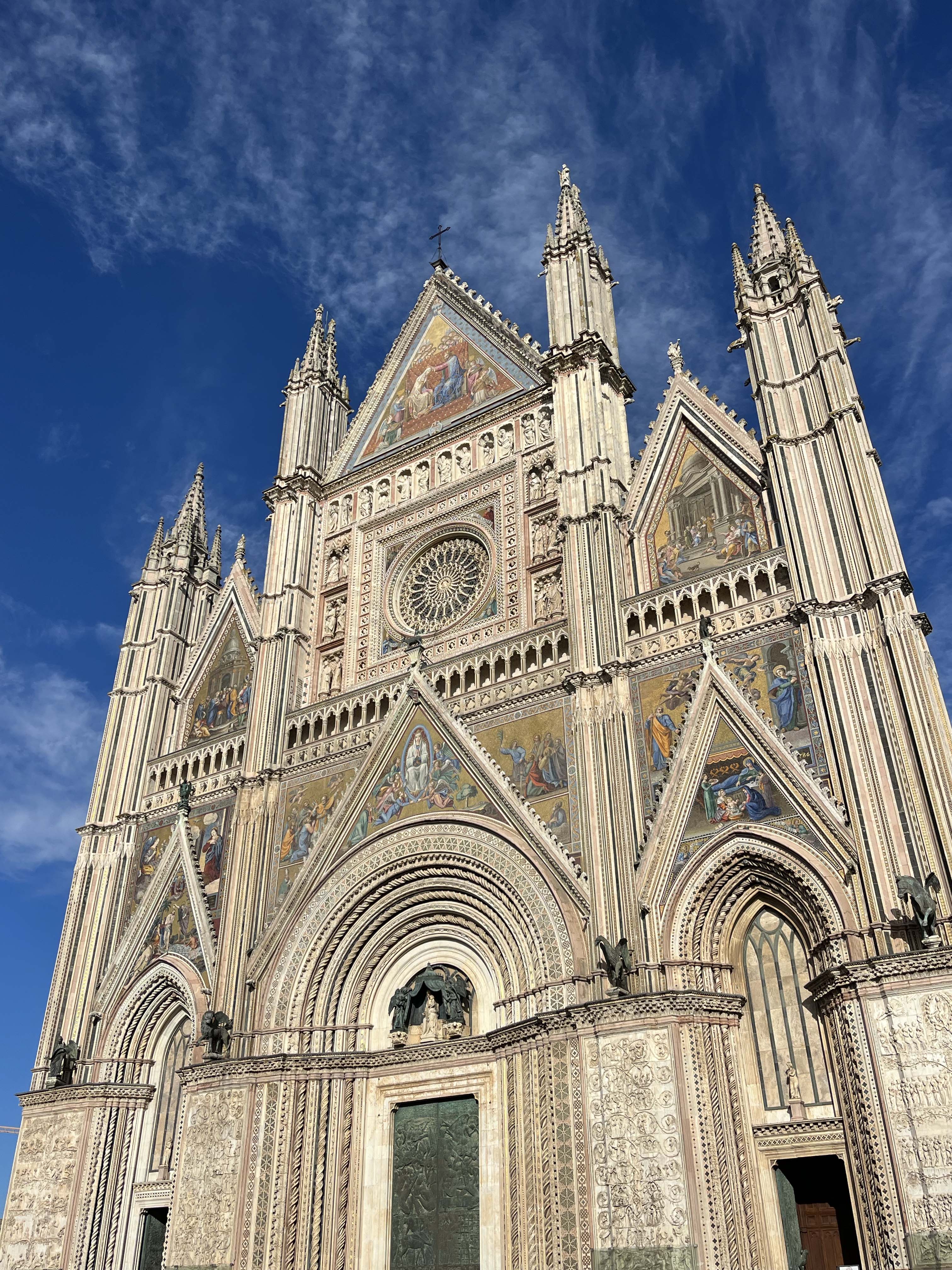
Your self-guided pilgrimage would probably begin at Il Duomo di Orvieto, a grand black and white striped stone building started in 1290. That’s what you did in 1290, build a massive cathedral with stones that had to be transported from somewhere else to the top of a plateau. Then after a couple hundred years employ some of the most famous of renaissance painters for the finishing touches inside and outside on the facade. You can’t help but feel in awe of humans from another time, of people from long ago who endured extreme physical labor to create an edifice most would never see finished. But if you think about it, still shared basic human desires with us today. Such a cathedral is not only an homage to the belief of Christians, or in some cases pagans, but to what humans are capable of.

Maurizio told me there are around 30 small churches in town, with only about 10 or so in routine use today.
“In medieval times, well-to-do people showed they were rich by having a church built. That’s why Orvieto has so many churches.”
My mother reads books on the towns she plans to visit before we arrive. Me, I just get the map out and walk, which is easy to do in Orvieto. Or it was during their shoulder season. I was alone in Il Pozzo di San Patrizio, a well completed in 1537. I had no idea what I was paying 5 euros for. What my ticket got me was a hike down 248 steps, 53 meters deep, in semi-darkness, and then back up again. I couldn’t stop thinking how anyone would know I wasn’t going to make it back up if my heart or lungs suddenly burst. About all they could do was watch me on close circuit camera.
Depending on how fast you walk and how many of the side streets you want to pass through, or how many photos you will stop to take, you can cover the whole plateau in a few hours, without much effort.
The hill town retains its history of millenia because the two German and British officers in charge of troops there during World War II met and agreed not to bomb the plateau. Some sense in a terrible war. The area around the plateau was fair game though and was completely destroyed to knock out an industrial center critical for producing steel. This agreement spared not only the surface history, but what lies underneath.
The Etruscans were the earliest known settlers of the plateau and left their mark on the area by digging into the ground to excavate materials to build the city above. They then used these areas for storage, travel, defense, and water. In contemporary times, the tunnels have served different purposes, such as for hiding during World War II. Or wine cellars.
A map of the tunnels reveals that they extend throughout the plateau. Anyone who owns a building in Orvieto has a piece of history from a few millenia ago below it. It makes it all the more impressive that the whole city hasn’t yet crashed down into itself.
I decided one afternoon to take the tour of the public tunnels to kill some time and walked myself into an Italian lesson. The tours alternate between English and Italian every hour. I didn’t have time to wait for the English tour an hour later so I thought, why not try it in Italian. I didn’t understand more than 50% of what the guide was saying, but I did know the word piccioni – pigeons. Yup, the Etruscans constructed rooms for pigeons, which they kept to eat, in the tunnels. Pigeon-sized cubicles covered the walls of such rooms, like the message boxes behind the desk of a boutique hotel. At first, I didn’t quite get the logic of building a home for pigeons under the earth, until I realized, we were at the top of a plateau. It was more like being in the penthouse of a skyscraper than underground.
Pigeon is still a common dish on the menu in Orvieto. My mom was looking forward to it, and I wasn’t sure what I was watching one afternoon when I saw a local feeding a few of the free range ones out on the street.
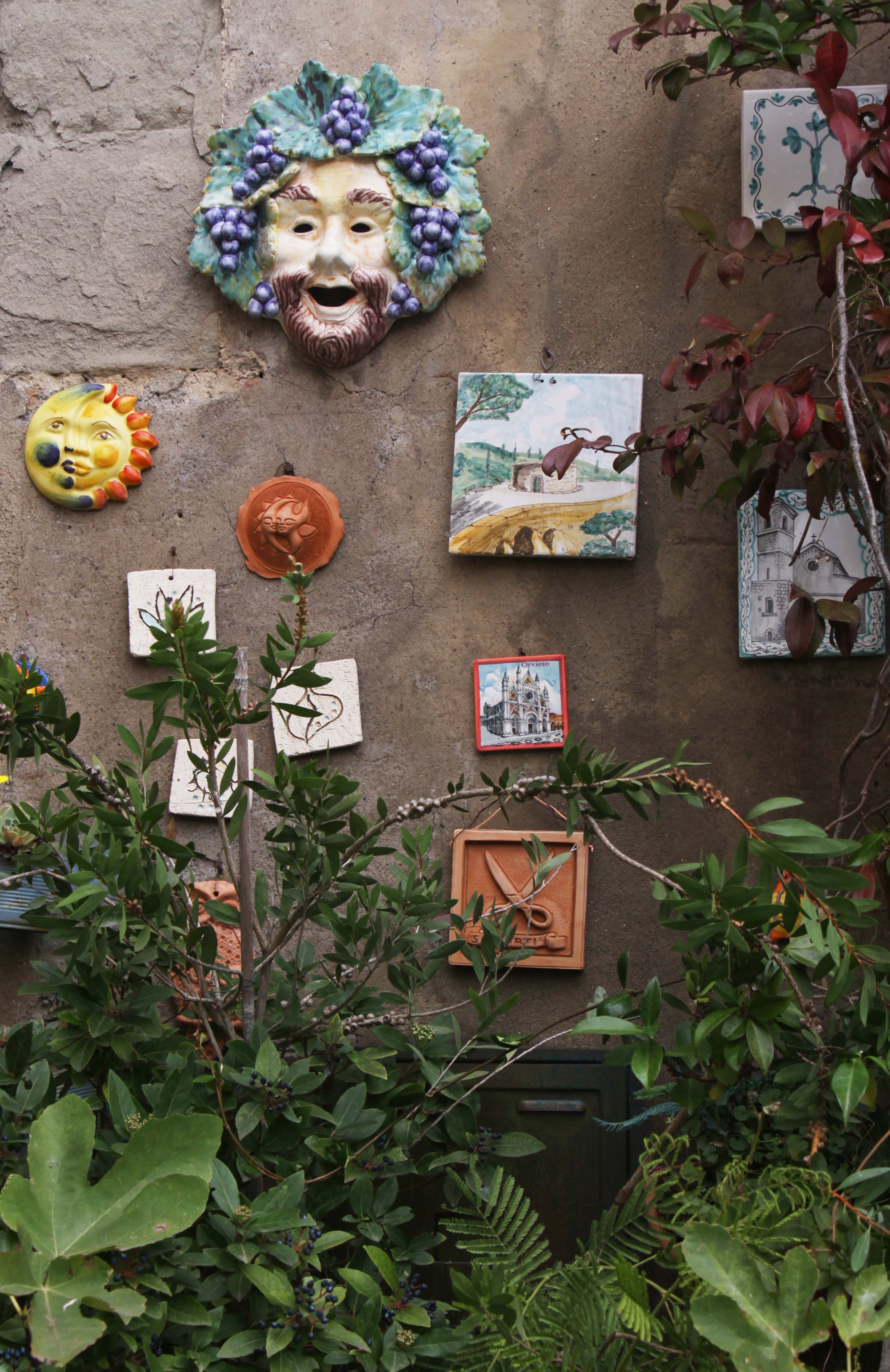
There’s plenty of art to view in the shops, and around the town, like the humorous giant wood carvings by a contemporary artist (Gualverio Michelangeli). But I got the sense that everyone in town at least dabbles in art. The locals mounted colorful ceramic tiles outside their homes or potted plants because there isn’t much room for gardens.
And people took time to speak to me in Italian. When we ordered a piece of house made walnut cake after our meal one night, the young waiter didn’t give up on my Italian.
“Con gelato?” the waiter asked.
“Frozen cake?” my brain translated his question. Sometimes you think too hard.
“Come? What?” I said, hearing congelato, remembering a word I saw at the bottom of some menus highlighting ingredients that were fresh or frozen.
“Con gelato?” he repeated.
“Oooh, con gelato. No, grazie,” I said.
The cake came, without the gelato, and not frozen.
“You see, con gelato, two words. Or congelato one word which means something else,” Maurizio explained to me back at the hotel.
Maurizio was right about restaurants in Orvieto. I felt as dumb as the time I asked if there was a good restaurant nearby my hotel in Paris. Maurizio’s number one restaurant in town is Trattoria La Palomba (meaning female pigeon).
“The best in town,” Maurizio said. “It will be packed.”
Maurizio tried calling for us, but the best way to get a table is to make a reservation in person during lunch hours. Like I said, Orvieto is not hard to get around in. I treated it as another opportunity to practice Italian – a few words, context dependent and I’m out before I get myself in trouble.

You know before you arrive in Umbria that you are going to try tartufi, truffles, that fungus in the soil, hunted by dogs and pigs, and the stuff of secrets and competitive business strategies. It’s no accident that you order tartufi dishes because they’re served everywhere. But it’s done before you even see the menu – their aroma fills the air, coopting the message system between your nose and your brain.
A shop owner told us eight types of tartufi are harvested in the area, and that the tartufi season is year round, even though some types, for example, tartufi bianchi, are limited to a season. I don’t know what nutritional value they hold. Whatever it is, we got it in La Palomba: bruschetta with tartufi neri followed by umbricelli (a type of pasta) with tartufi neri, and finally filetto with tartufi neri. The waiter liberally grated the tartufi over each of our dishes right at the table. After this meal, I decided when people ask me what to eat in Italy, I would say, “Get the fresh pasta with whatever is local and in season wherever you are in Italy. You’ll never be disappointed.”
Maurizio also recommended a restaurant where the owners made the caves below their property open to their diners. For our last night, I reserved a table at Labirinto di Adriano again during lunch hours.
“Sure, 19:30,” the waiter there said. I felt the man was humoring me, showing respect to my efforts to make an exchange in Italian, that were so not necessary during the town’s down time.
When we arrived that evening at 19:30, the restaurant was empty. Not a soul around. A woman finally came to seat us, and we sat down to order from the limited menu, which is a sign of a good restaurant, in my experience. I ordered guancia di maialino, an over-the-top indulgent choice of pork cheeks braised in red wine with pistachios and stewed purple cabbage. Just the right mix of protein, the rich taste of fat (which melts away with cooking) and fiber.
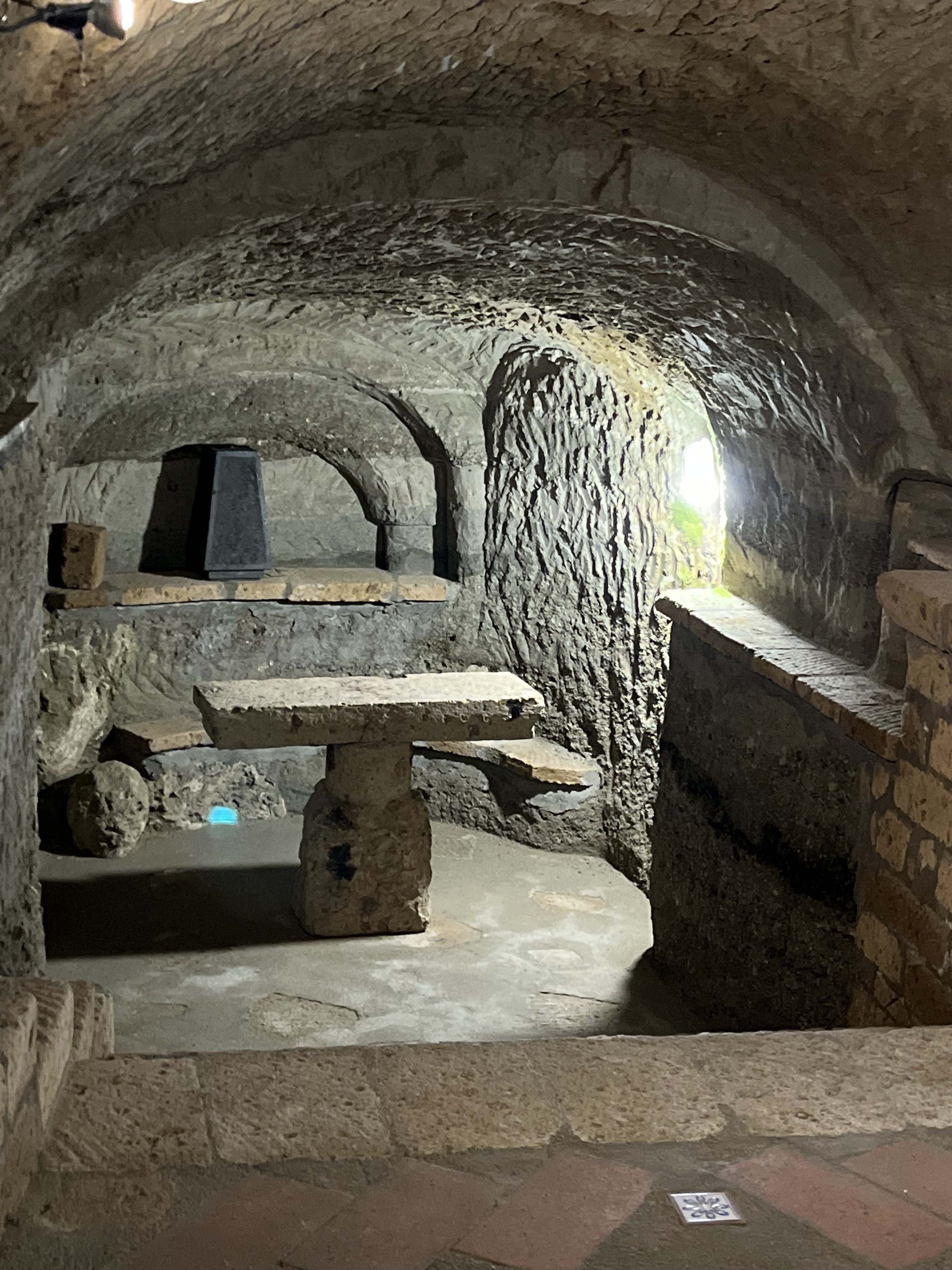
After we finished eating, we traveled into the earth for our side of culture. When we returned to the surface, the four Italian men sitting at a table near us asked, in Italian, what was down there. I did my best to describe what I had seen underground in their language. That they asked at all was a shock. The difference between southern and northern Europeans – Italians will talk to strangers. Never would have happened in Norway because according to a Norwegian, Norwegians don’t talk to strangers even if they’re Norwegian.
Diners will find an area at the entrance of the caves to be converted into a wine cellar. The rest of the area is a labyrinth of rooms, tunnels and staircases to more rooms, tunnels and staircases, carved out by the Etruscans. Also on display are remnants of the art and pottery Etruscans are famous for, which gave me more of a sense that humans built and lived in these areas than the public area near the cathedral. But the public caves have the pigeon nests where the birds flew in and out of a window cut into the outside wall of the plateau.
“He was born in front of Il Duomo,” one man said about one of the others, when I asked where they were from.
“You speak Italian better than he does,” another said.
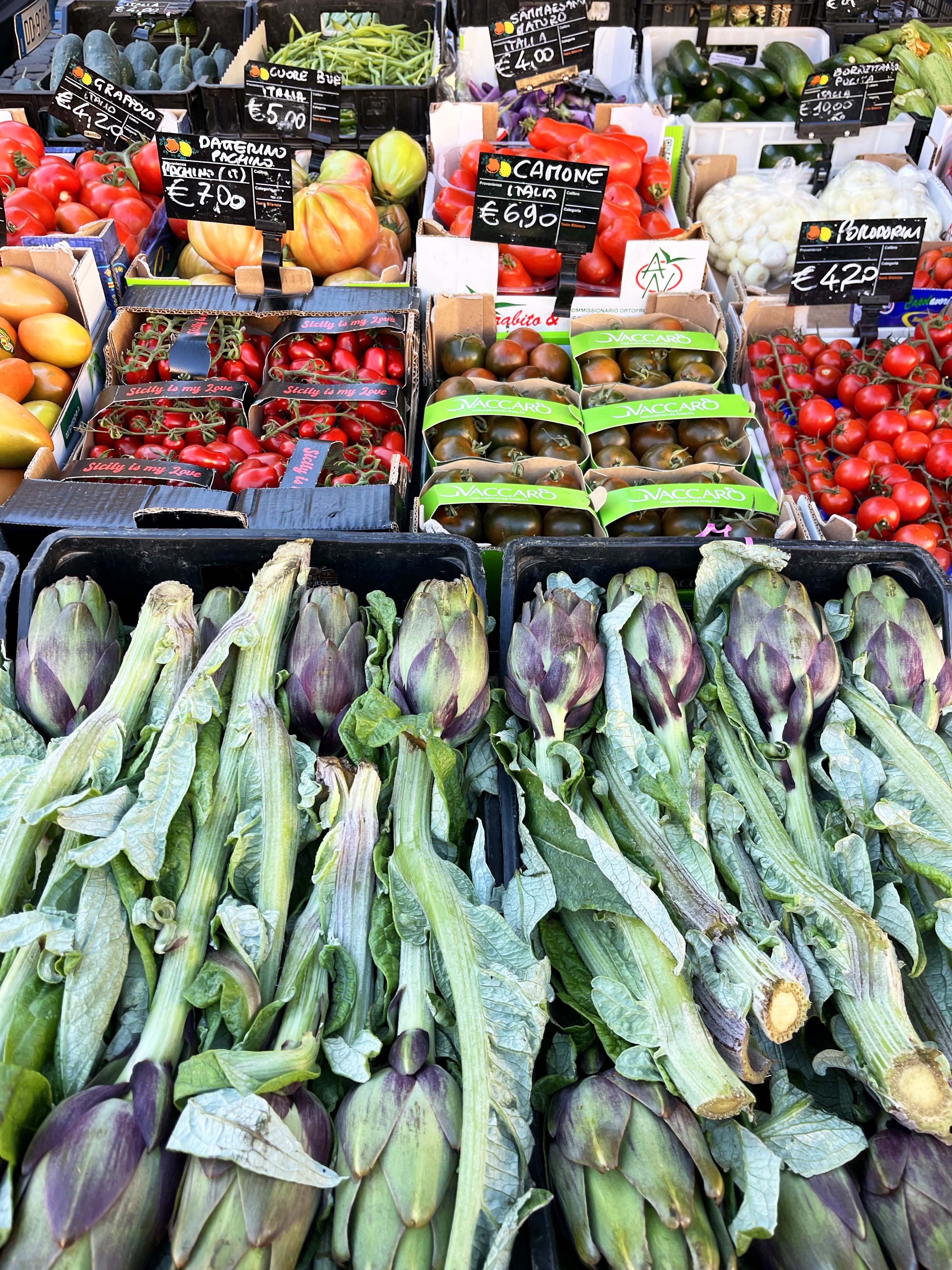
The temperature dropped to nearly freezing the morning we left. We had a quick tour through the farmers market on a Thursday selling fresh vegetables, fish, and sausages and cheeses. We took the smart way down to the train, a taxi, about five minutes for 20 euros. The driver told us his family has been living in Orvieto for three generations.
“You should come back to live here for a while,” he said.
“The food is simple but good in Orvieto. All I ate in Miami was hamburgers and bacon,” he continued.
Somehow that sums up what the difference might be between American and Italian cuisine and culture, in less than 140 characters.
And well, Maurizio at the hotel, plus the fresh squeezed juice from Italian oranges at breakfast, made the price we paid for our room worth it.
Books…
Norwegian Lessons in Indonesia (2023)
An Accidental Artist: Discovering Creativity through Scuba Diving (2018)
Art for sale at AnemoneWatch on Square
 Janice Nigro
Leave a comment