Planning a trip isn’t the kind of activity that should break your brain. To Europe anyway.

I’ve traveled there so many times, and even lived in Europe – seven years. And yet, I mull over the options until it’s like a last minute cramming session. When I’m planning to travel to Europe, I feel the pressure to visit everyone I know there, when I know I can only visit a few friends, and usually only the ones living in Italy and Germany.
For a trip in November (2023), I had planned to arrive a few days before my family to attend a birthday party in southern Italy for a friend in her hometown of Carovigno in Puglia. That left me with only two nights to plan on my own. One was reserved for Roma so that I could meet my mother at the airport when she arrived from Chicago. The other night was open. Two nights in Roma? Or should I delegate one night to Bari, a small seaside town I’d never been to?
A night in a city on my own, fumbling through my Italian with non-English speaking locals in a place where I’m unknown, the decision should have been easy. If not for any other reason, more adventures mean more stories. Still I left booking a room for one night in Bari until a few days before I left. Another town interjected into my itinerary meant I would have to drag my bag off the train and on again, up some stairs, but I was going to have to do that anyway. Still there was that nagging feeling I might never travel so far south again. And the cost to stay in a hotel in Bari for a night was half the price to stay in Roma for a night.
“An afternoon to look around in La Città Vecchia (Old Town Bari) would be enough,” my friend Vita told me.
That decided it. On my way up to Roma from Carovigno, where I’ve been countless times since my first trip to Europe at sixteen, I would spend one night in Bari.
Aside from recognizing the terracotta walls and the ivory arches of the train station from the photos on the internet, I knew nothing about Bari. Old town, new town – that was it.
“I want you to try something,” Vita said as we left the station, Bari Centrale. Vita was on her way to the airport to fly up to Verona where she lives, but she had time to have breakfast with me. We zigzagged down the main street, radiating out from the front of the station, from shop to shop, until she found what she was looking for.
Martinucci, a popular southern Italian bakery.
The contemporary sterile, laboratory-like shop, typical of new malls, displayed rows of overdoses of sugar in the case. I didn’t know what I was looking at.
Pasticciotti.
I’m not that into pastries. I like chocolate and fruit for dessert. But the algorithm changes in southern Italy. Even the pastries offered for breakfast in hotels are worth dedicating a few extra calories to each day. That’s how fresh and good they are there.
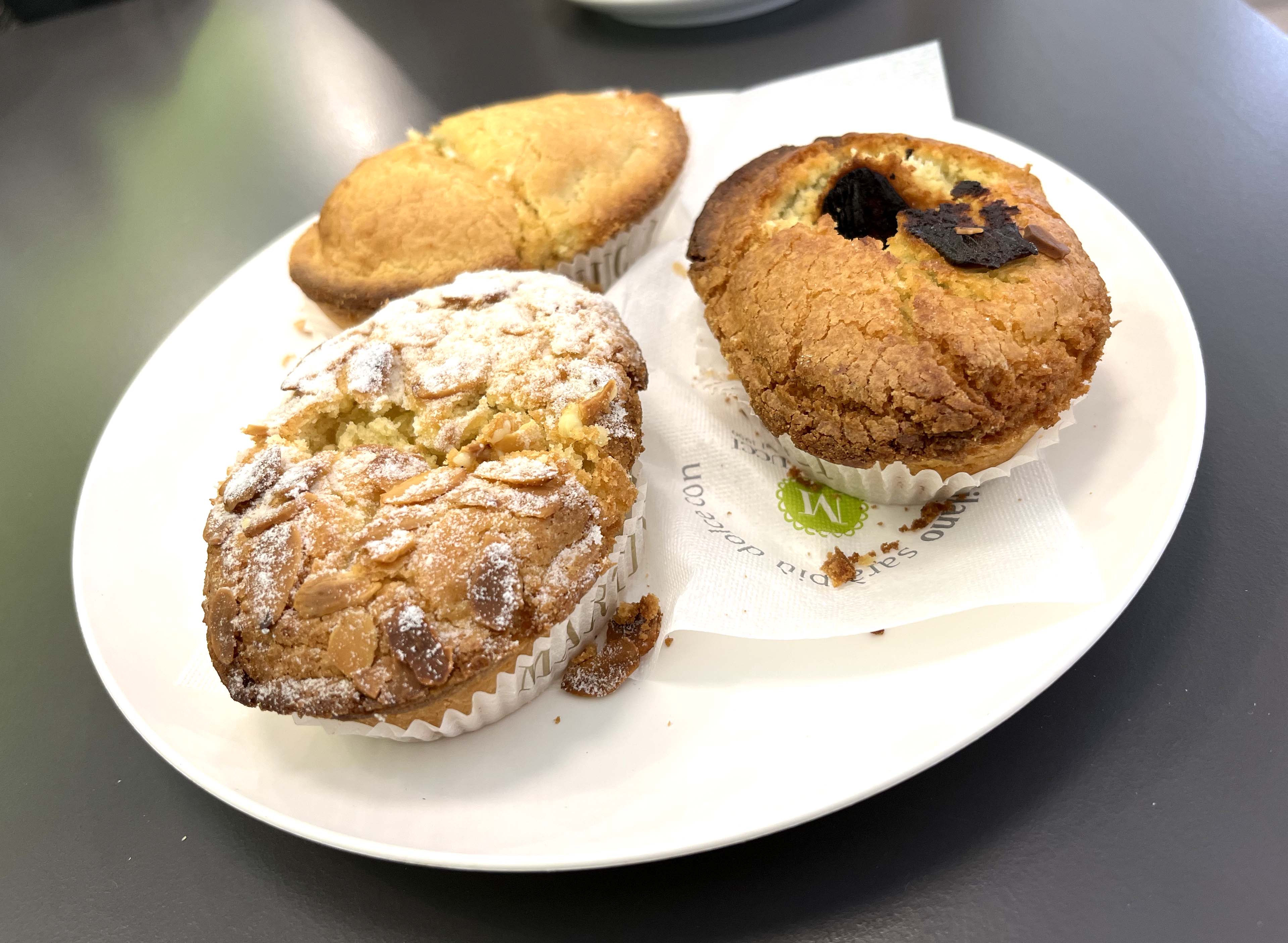
“Which one do you want me to try?” I asked, watching Vita’s long lashed, big brown eyes wake up after our early departure from Carovigno.
“I want you to try all of them,” my personal guide replied.
I laughed.
We didn’t try all of them, but by the end of our pastry exploration, I felt like we had. The pasticciotti are servings-for-one, oval shaped, crumbly crust pies with a creamy filling. The pastry was invented from scraps a couple hundred years ago in a small town further south, Galantina, where the descendents of the originator Nicola Ascalone still run the bakery opened in 1740 (Robyn Huang, “In southeast Italy, this pastry is king”; The Washington Post, August 29, 2022). Vita chose three different flavors: classic, pistacchio, and lemon. The moment I bit into the first pasticciotti erased any hesitation I’d had about stopping for the night in Bari.
After finishing all three, and the crumbs, I couldn’t eat anything for most of the rest of the day.
Before she left for the airport, Vita checked Google Maps for my destination, a bed and breakfast a few meters from the sea, to make sure I would find it.
“Oh yes, look you just keep going straight this way and then you’re there,” she said.
Like magic.
“Arrivederici,” we said, squeezing the breath out of each other one last time.
La Città Vecchia resides on a small peninsula jutting out into the Adriatico. At sea level, a white castle and its walls are its only defense. I headed in the general direction of the bed and breakfast, dragging my bags across the cobblestones, while Vita left in the opposite direction for the train to the airport for her flight to Verona.

I walked to the end and found myself outside the castle walls and at the waterfront. I headed back inside and asked a woman where via Pier l’Eremita was. She shook her head no, but I got the feeling I was in the kind of place where everyone knows where they are and how to find where they want to go, but they don’t know how to tell you where they are.
They were born there, their parents were born there, their grandparents were probably born there. Their DNA must encode for a GPS that tells them this is how you know where you are. It was anecdotal verification of the Nobel Prize awarded to two Norwegians for the discovery of neurons in our brains dedicated to navigating our worlds.
A local man was more gracious, asking not for the address, but the name of the bed and breakfast.
“Oh, sì. Vicino. Direttamente,” he said, pointing up the street.
The door was locked under the sign for the bed and breakfast. Next door was open, white linen curtains hung over the entrance. I stepped in, even though no lights were on, and backed out immediately when the neighbors to the bed and breakfast yelled at me to get out of their home.
Now I understood. The curtains said, “We’re home.” But they were not an invitation to just anyone to walk in off the street. A level of trust I’ve never experienced in any neighborhood I’ve lived in.
I called the number of the bed and breakfast, and the woman who answered came down the stairs of the bed and breakfast and let me in.
The bed and breakfast occupied the space at the end of a wall of homes constructed out of stone as residences for fishermen centuries ago. The bed and breakfast was no longer the home of a local barese, but I had an idea of the space of the neighbors next door and the way it was arranged therein. I had booked La Camera Corallo, the coral room, a room with a theme of coral and sea life. Choosing a room in La Citta Vecchia based on the room décor appealed to me, and the choice was easy for me, a diver. I climbed the staircase with enough room for me, not very many centimeters tall, and my suitcase. The room was just one floor up, and a single twist in the staircase.
The room had a bed, a refrigerator, a bathroom and a balcony, which has only a view of what is happening on the street below, or the building across the way, close enough to pass the salt from one inhabitant to another.
The map of the old town sitting on the desk looked as interpretable as the squiggly lines my toddler niece uses to imitate Mr. Toad’s list of things to do today. Now I understood why no one could tell me which street I was on. The way to get around is to just go.

The buildings of La Città Vecchia create the shadow protecting you from the direct southern Italian sunlight, and they curve around and open up into some grand or quaint piazzas. My favorite piazza was San Maria del Buon Consiglio, a small piazza built around a few remaining columns of a 10th century church. I felt like I was sitting in an area of the Roman ruins, but it’s a tight piazza off the main street where you can sit and eat your focaccia without anyone else around to bother you, except for maybe a cat.
History surrounds you in a city fortified by the walls of the castle built in 1132 by the Norman king of Sicily and includes the Basilica of St. Nicholas also from the 12th century.
But you pass by open doorways decorated with the white lace curtains, that only feel a draft when someone walks by. I felt like eyes were peering out at me, a stranger, from their windows. And you can hear chatter of the people therein or from the TV. When I stopped to take a photo of a truck, designed for the narrow cobblestone streets in Italy, I heard the window open behind me, now embarrassing me to be taking a photo of perhaps the owner’s vehicle.
I turned around and the woman in the window said in Italian, “Take the photo. Go on take the photo.”
Neighbors darted across to open doors on the other side. I got the sense I was walking through an extension of everyone’s living room where people sat, making orecchiette or eating and having a drink. “Come on in” the scenes in the street seemed to say. No wonder I made the mistake of stepping into a home my first minutes there.
The atmosphere invited you to interact with the locals, if you spoke a bit of Italian. One older woman told me she was living in her father’s home. She confirmed my suspicion, that the way of many people there was the way of their ancestors. Old town in some ways, modern in others. When I told her how much my room cost, she raised her hands in that “mama mia” way.
Every once in a while the maze threw me out, and maybe as a light sensing organism, I sought the sun and the sea, where retired men chatted and couples strolled on by.
“Beautiful hat,” one said to me in Italian.
When I felt like it, I dove back into the maze to try to find I don’t know what. All I knew is, I would know when I found it.
I went around and around, taking photos of doors and windows, and pots and plants hanging on the walls or placed in window sills. Or laundry. A pair of men’s underwear plopped on the street just behind me. I thought, do I pick them up? Do I ring the bell to tell the resident their underwear has fallen?

I dodged the signs displaying images of Barese comfort food, the tentacles of fresh octopus protruding from the open side of fresh bread roll, like a cartoon character from Sponge Bob crawling out of rocky crevice. I wasn’t tempted in the least, but I wasn’t a barese either.
But Bari was my one stop in Italy right on the sea. If I was going to eat seafood, octopus or another critter, I should have had it there. My excuse, the pasticciotti I’d eaten for breakfast. I was so full, I didn’t even stop to buy a focaccia in a panificio, Panificio Santa Rita, I kept passing by that always seemed to have a line in front of it.
I finally succumbed to hunger after almost eight hours of walking in and out of the labyrinth. I stopped for pizza in a restaurant meant for tourists. Yes, the kind that’s open at 18:00 when you know restaurants in southern Italy don’t open until 20:00.
My Italian words came stumbling out when I entered. The man at the door announced to another to seat me at a table for one with a menu in English. The words were too slow to come out to protest. I ordered a thin crust Barese-style pizza, cherry tomatoes, ricotta and rocket, with a glass of white wine.
The next morning I headed out to Panificio Santa Rita to see what went on in there. I left to reach my destination before the opening time of 8:50 – 8:50? – and found people already waiting in line.
The clock ticked on past 8:50, and the longer we waited, the more Italians in line surrendered and left, maybe to return later. The Italians staying behind offered some theories on the disregard of puntuality, that the proceeds from the previous night had been so good they didn’t need to open as early.
Santa Rita opened at 9:20, 30 minutes late.
“It’s southern Italy time,” Vita said. “But Bari has the best focaccia.”
The proprietor handed over my piece of gold, a whole focaccia with tomatoes and a few green olives. Warm, right out of the oven, and only 3.50 euros. I bought a basket of local mandarins, I could share with everyone I met, for an even cheaper price from a truck parked nearby, and celebrated my 24 hours in Bari back in La Camera Corallo.

My time was up. I left my coral colored room for the train. A gracious man helped me lift my suitcase into the bin overhead and I sat in my seat on the right side of the train, the side with a view of the Adriatico until the train veered inland, leaving behind a city retaining its medieval charm.
Maybe southern Italy is still imprinted in my DNA. Maybe my DNA tells me I’m home when I’m there.
Books…
Norwegian Lessons in Indonesia (2023)
An Accidental Artist: Discovering Creativity through Scuba Diving (2018)
Art for sale at AnemoneWatch on Square
 Janice Nigro
Leave a comment