“Are you carrying a lot of money?” the customs officer asked at the airport in Bari, Italy.
“Ummm, no,” I said, not sure how to answer that question out loud in front of strangers as I was about to board a local train, with luggage, to a city I didn’t know.
I was on the second leg of a 20-hour trip to reach the small town of Carovigno in Puglia. On my way to a birthday party for an Italian woman, Vita – Life, her younger sister calls her – who has been a friend of mine for almost two decades.
I met Vita when she arrived at the cancer center at the University of California, San Francisco, as an Italian visiting scientist who didn’t speak English. My colleagues introduced me to her because I was taking Italian classes at the time. Gelato, risotto, pasta – we managed until her English in a few months became much better than my Italian ever would be.
Her reasons for studying cancer were personal. Vita’s own father died in his early 50’s from glioblastoma, a devastating brain cancer diagnosis. My reasons were a graduate degree that took a detour.
In the odd way the world works, I left the USA before Vita did. A six-month sabbatical that turned into seven years in Norway. Vita eventually returned to Europe on a sort of country crawl through four nations that started in Scotland and ended in her homeland of Italy where she now lives.
While I was living in Norway, Vita invited me to visit her in Carovigno one summer years ago. I took a slow train from Roma to reach Carovigno, in August. The trip took most of the day, and it was so hot that Vita, who I knew to have straight hair, ditched the blow dryer, allowing her hair to dry naturally into a full head of loose curls. She was another person in Carovigno.
Vita’s relatives all lived nearby, around the same town square, the same building. Her uncle still lives in the apartment below and her grandfather lived in the apartment below that at the time. Every day her grandfather came up for lunch, the main meal of the day, and contributed by grating the parimigiano. He held the grater (grattuggia), the kind structured with the grater over the top of a bowl, close to his chest, and with an almost lyrical, circular motion, grated the cheese we used for lunch.
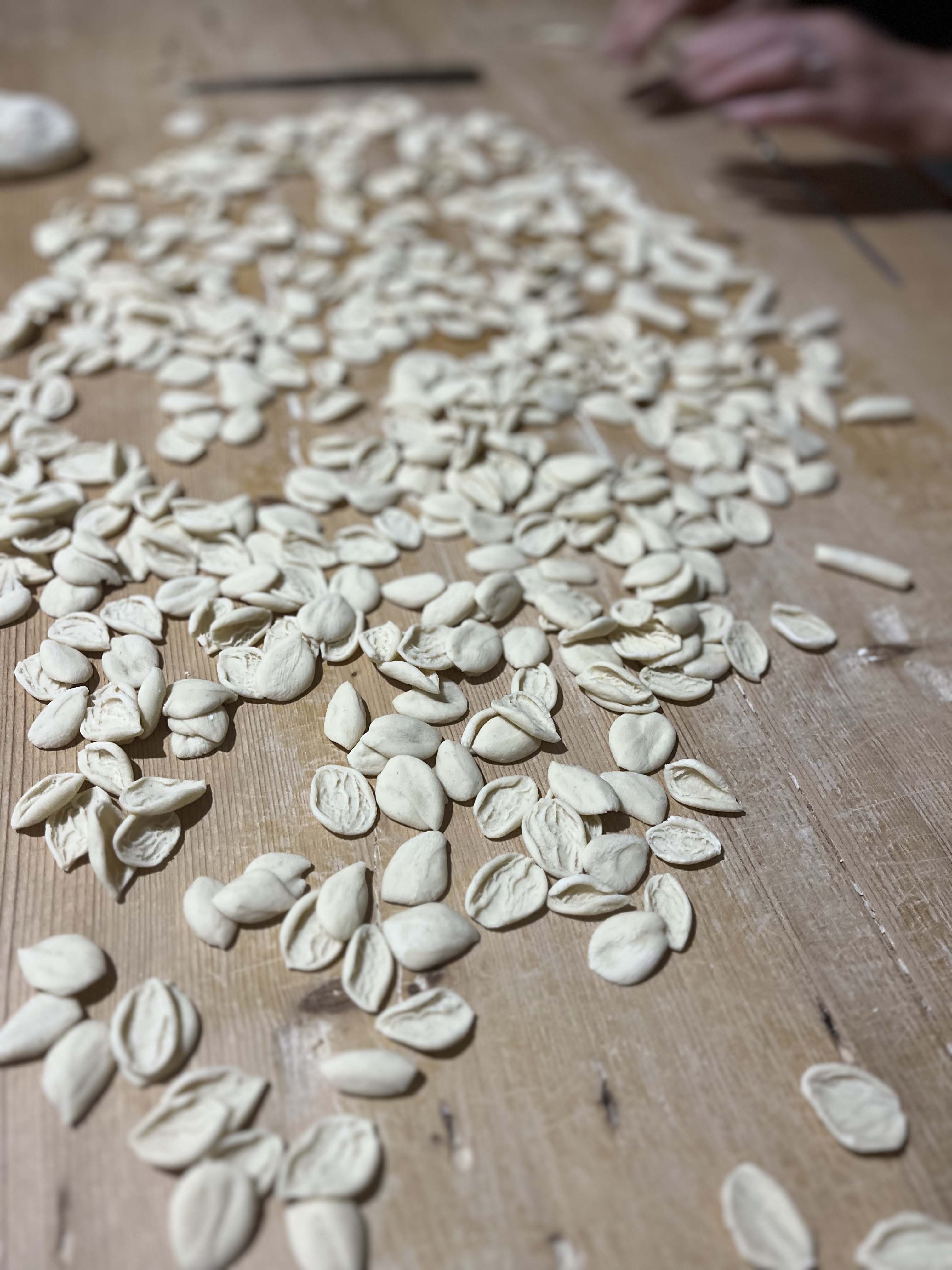
Rosa, Vita’s mother, nurtured my Norwegian diet with pasta with eggplant (fresh from the market), risotto with mushrooms, and orecchiette with homemade tomato sauce. And I had my first lesson on how to make the orecchiette, the traditional regional pasta. A hot summer afternoon and in 45 minutes Rosa, without air-conditioning, filled a table with the fresh pasta while I produced none.
“She’s been doing it for 60 years,” Vita said.
No one spoke English. We could say anything anywhere and no one understood.
“Please don’t worry. My aunt is not yelling. That is just how she talks,” Vita said, providing me with critical context in the absence of understanding the local dialect, or heck, any Italian at all.
Half of my DNA immigrated from Sicilia, and Carovigno was far enough south for me to think there might be some distant Nigros in town.
“I knew you were going to ask me that,” she said, as she pulled up next to a building with the sign Nigro Agenzia di Viaggio on the front of it.
I felt like a celebrity those few days that summer. Like I might get into the local newspaper.
“The American?” her grandmother asked when we visited her across the courtyard from her family’s apartment. The postman switched to English while weighing my post cards, for what reason I did not know. The owner of a bakery, il fornaio as Vita called him, a man so handsome Vita was tongue-tied in front of him, handed me focaccia filled with ham and cheese and tomatoes without charging me.
Local entertainment had a distinct style. One day at the beach, a 10-minute car drive from her home, we watched a woman fishing the Adriatico with a baguette on her line, casting from her beach towel on the sand.
“She needs some ham and cheese,” Vita said. I felt like I now understood how her sense of humor to make me laugh at something that was nothing developed.
So when I told Vita I was coming to Italy in November (2023), she said, “It’s my birthday and I’m celebrating in Carovigno. It would be wonderful if you would come.”
I adjusted my travel plans to arrive in Italy a few days before the rest of my family to meet Vita in Carovigno.
The trip to Carovigno was no minor commitment on my part. The long haul flight on the A380 carried a few hundred passengers from Los Angeles to Munich. I waited a couple hours to catch the smaller flight from Munich to Bari on an Embraer 195, run by Air Dolomiti, with maybe a hundred passengers.
I took a city train to the Bari central station where an hour later, I caught a local train to Carovigno. By that point in the trip, I needed a sign saying, Wake me for Carovigno. It wouldn’t have helped much, as I was one of only a few passengers left riding the train at 19:40 to Carovigno. Not even a conductor came back to our car to check for tickets. I worried about missing my stop until I remembered that Carovigno was after Ostuni. I asked anyway, in my first words in Italian in two years, if Carovigno did come after Ostuni.
“Sì,” said the woman.
I disembarked at Carovigno, alone, on the side opposite the station in the dark. Even though the station was outside of town, it was sophisticated enough to have a tunnel under the tracks to reach the platform on the other side. Dimly lit. No escalator or elevator. No one had to watch as my two bags bounced down the stairs. There, there in the middle of the tunnel, in the bluish light, is where I met my friend Vita. After we squeezed the breath out of each other hello, we navigated the suitcases back up the staircase on the other side and drove over the gravel road out onto the main street taking us to her mother’s apartment in town.
Bits from my first trip began to come back into my conscience. That her mother’s apartment was in the same building as the carabinieri. Maybe an extra layer of safety for this family of women after the husband and father had died. That someone would buzz us in. That we would climb a marble staircase to the top apartment made up of a kitchen, two bedrooms, a bathroom, a living room with a small balcony, and a rooftop terrace with a view of the town and an entire garden growing in pots.
Rosa loves roses, but she goes up to the rooftop terrace to pick fresh herbs for her cooking. And to hang her laundry. The bathroom had been renovated since I’d been there – a shower now took the place of an old-fashioned clawfoot tub. But that everything happens in the kitchen you can’t miss. Because there’s a couch that sucks you in set against the wall beside the cozy kitchen table covered with a flowered oilcloth.
And there were new faces. Vita is now an aunt to two young girls who inherited the dark eyed and dark haired beauty of their mother, their aunts and their grandmother.
I arrived in the perfect state to Rosa’s kitchen, starving. The breakfast was so horrible on the long haul flight from Los Angeles to Munich, even the yogurt, that I hadn’t eaten in almost 20 hours. I considered leaving the train station in Bari to search for something to eat, but I didn’t want to lug my suitcase around the city on an empty stomach. Instead, I got homemade orecchiette right out of a boiling pot of water and served to me with tomato sauce made that afternoon. My in-home orecchiette lesson had begun. Rosa brought out the box of fresh tomatoes to show me the ingredients she used to make the sauce, and then a small jar of the priceless liquid leftover for another meal.
Meatballs made of strips of pork, rather than ground meat, and air fried, followed, and I sopped up the sauce in my bowl with focaccia fresh from the panificio that day. An orange from the region for dessert. Up to that moment, I had been conflicted about taking Vita’s invitation to stay in their home. I didn’t want to be a burden in the limited but warm space that they had to offer. It’s when you begin to consider how long you take to brush your teeth.
“Of course it’s not too much for us. I didn’t think about it. But maybe it’s too much for you?” Vita said.
Maybe I was being selfish, but I had wanted to stay there to be a part of everything. I would have missed breakfasts of pancakes with homemade lemon marmalade. Or dressing for the birthday party. Or the lunch of pasta with lenticchie and homemade lasagna. Or new words in Italian.
On Saturday night, on the way to Masseria Stefanodelconte, the location of the party, we picked up two cakes in Ostuni, one for Vita and the other for her 10-year old niece, who shared the same birthday. Enough cake that pieces of the leftover pastries were distributed throughout the town the next day.
An electric gate opened, allowing us to drive into the grounds of Masseria Stefanodelconte, a restored olive mill of whitewashed plaster, modernized for house guests in summer. In the Italian sun and soil, it’s olive trees, not palm trees, that crowd the landscape surrounding the old mill. Olive trees that have seen history. Olive trees hundreds of years old, now in peril from a virus carried by an insect. We walked past courtyards, a pool and open air passageways to reach the room where the party took place. Candles and a fire provided the light. Pinkish-red tulips added a few spots of color to the neutral background of the rustic design of the room. The ambience was a long way from even San Francisco.
Food (focaccia, cheese, prosciutto, warm involtini…) sat on a table buffet style, allowing you the freedom to eat more than you needed. Like so often, the thing that impresses you the most on the menu is not what you expected. This was not the kind of place that served eel gelato – yes, it was on a menu I ate at in a restaurant in Sorrento. That thing was the ricotta. A cheese. Maybe not even really a cheese, not in the classic sense. It was the most delicious ricotta I’ve ever tasted, maybe because of the cows, or the sheep, or the combination of the milk from these animals and what they eat and drink in this part of the world.
“I take ricotta home to Milano with me because it’s so special here,” Vita’s brother-in-law, a man from Milano, said in the halting English he committed to practicing with me before I arrived.
I had no choice but to speak Italian at the birthday dinner, but I had my I’m-an-American moment when I asked the waiter to cut a ball of mozzarella di bufala in half for me.
“No, it is not possible,” the waiter said. So, well, I ate the whole thing.
On Sunday we went out to get some fresh focaccia and pettole (fried dough) from the panificio. And I got my second in my life in-person orecchiette lesson from Rosa who, at that point, had another 15 years of experience on me making the local pasta.
Rosa brought out her faithful tools from forever, maybe they had been her mother’s, or grandmother’s, the wooden board, the sifter, and the knife. The board, almost as big as the table, was placed across one end of it. The board had ridges, ridges my own mother would later remark provided the resistance necessary to help shape the orecchiette.
“Un po’ di aqua tepida,” she said. A little bit of tepid water she added to the mound of flour she had eyeballed to make enough orecchiette for the four of us, and some salt – no eggs as I was accustomed to making my pasta dough – and kneaded the ingredients together until the dough felt correct to her more than half a century of experienced touch.
Without resting the dough, she began to roll it out in long snaking pieces and then cut off the end, shaping the orecchiette with the knife and her forefinger like a swift operating machine. Humans must have evolved the forefinger to make orecchiette. Rosa humored me, allowing me the honor of using her knife, because it worked the best to make the orecchiette. But even the knife couldn’t help me, and she took it back after a few minutes. The statistics, Rosa versus me, hadn’t improved since I last visited, although I hadn’t put in my 10,000 hours either.
On the menu was orecchiette cime di rapa. Sctachiodi cu li rabucavuli in their local dialect Vita’s cousin’s husband told me. I can’t even find these words on the internet. Now they will be.
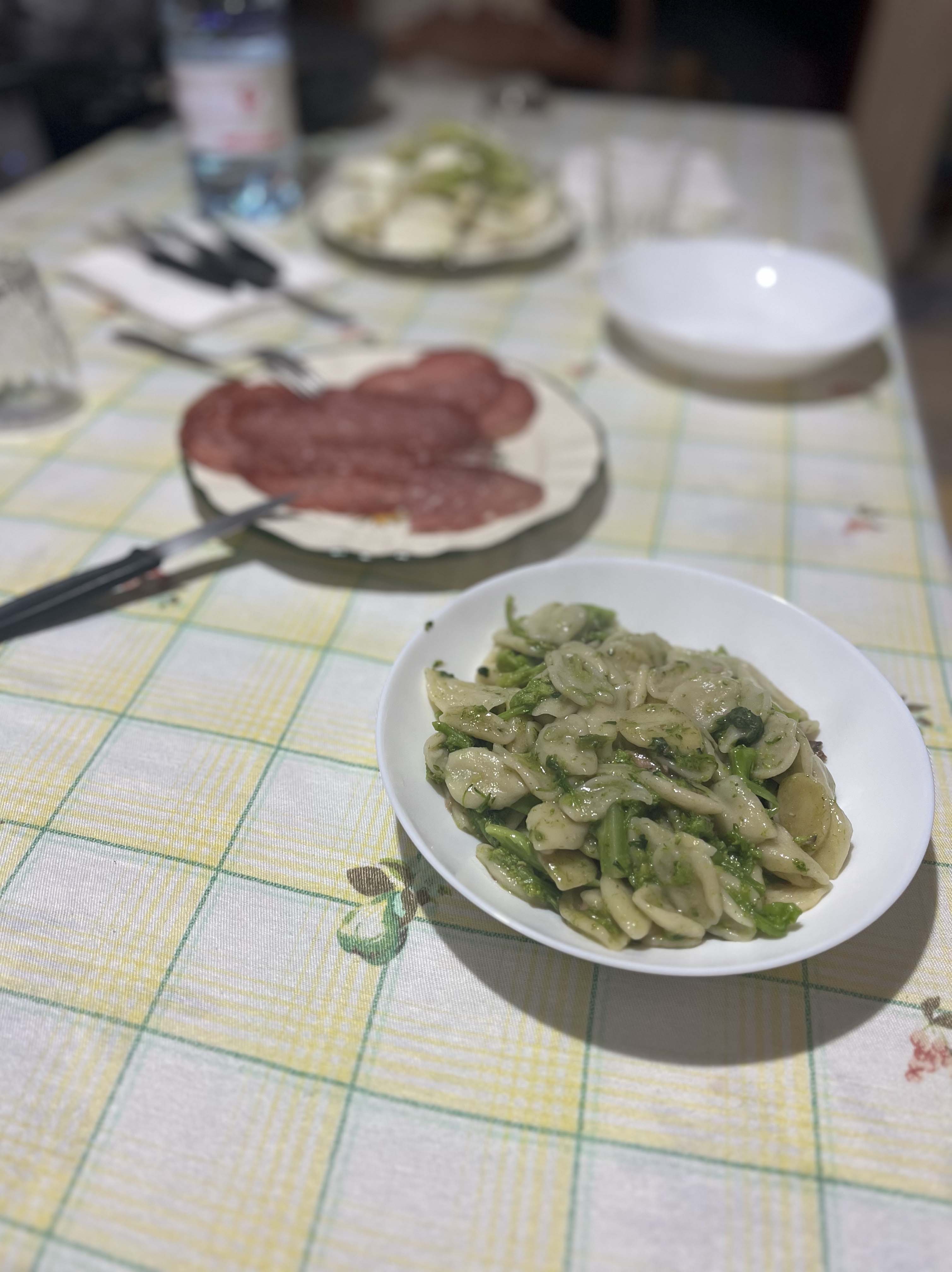
The orecchiette went into the boiling water falling to the bottom of the pot. When they rose, Rosa mixed them. Again they fell to the bottom and when they rose once more, they were done.
“This is how we measure cooking time here in southern Italy,” Vita said.
They were delicious.
“My daughters don’t want to make them,” Rosa said, lamenting the next generation’s disinterest in continuing the tradition.
Vita corrected her mother. Yes, Rosa had to admit Vita did make orecchiette.
After dinner, Vita and I walked to the center of Carovigno, just five minutes away. We meandered through the narrow cobblestone streets lit with festive white lights. You can’t compare the culture of any American city with that of even the humblest of small towns in Italy. White walls with potted plants and other outside art hanging from them. And we don’t have castles (Disneyland doesn’t count). Even a small town in Italy in Puglia, like Carovigno, can boast of having a castle.
The castle has been around for a thousand years, a defense against the world’s history of infamous invaders. But in the last century, the building became public and was used as a school for a brief period which Vita attended. I don’t know anyone in the USA who has gone to school in a castle. Much less a person from a town of 17,000.
On Monday morning, we traveled together on an early train back to Bari, and there we parted ways. She to the airport while I stayed for a night in the old town of Bari on my way to Roma. I left with some new videos of her mother making orecchiette to be studied over and over by my brother at home who relaxes making fresh pasta. The quality of his orecchiette could withstand review from even Rosa, but in a cooking challenge, which would be amazing to have, Rosa would be able to beat my brother by the sheer number of orecchiette she can make on her own in a half hour.
I didn’t know what to eat after Rosa’s homecooked meals. And I was in Italy. I could have had the bed and breakfast in Bari arrange a homecooked meal with a local woman nearby, but I already had been treated to the best.
Vita who lives in Verona drove me by the Adriatico one afternoon, a ritual if it’s not summer when she visits. After a few moments, breathing in the sea air, she told me it was her wish to one day live in a house by the sea in Carovigno.
“What is America like?” people around town asked Vita when she was living in the USA.
“Does anyone in America ask you what is Carovigno like?” I asked her.
“Of course not. Nobody wants to know where I come from,” she said.
Yes I know, I know it’s better to ask.
Arrivederci Carovigno…
Books…
Norwegian Lessons in Indonesia (2023)
An Accidental Artist: Discovering Creativity through Scuba Diving (2018)
Art for sale at AnemoneWatch on Square
 Janice Nigro
Dear Janice.
I really enjoyed reading about your trip to visit Vita. Hope you both are happy and doing well.
Take care😊
Hi Tom! I get over to Italy almost every year since I’ve been back from Norway except during Covid. She’s in Verona now so it’s easier to get together although there’s never enough time. She’s still a riot :)…thanks for taking the time to read the story…