Gelato, cioccolato and pasta. You can marinate yourself in history, culture, and art in Italy. And then there is gelato, cioccolato and pasta. Any bad day, even if you’ve been pickpocketed (unfortunately I know the feeling), can end in one of those shops and erase any negative feelings you have about what happened, or didn’t happen, during waking hours. I must be right because I saw Brooke Shields in a chocolate shop in Firenze I didn’t know anyone else knew of.
But maybe I’m more proud of the fact that in any one of those places, I can complete a transaction all in Italian and get what I think I’m asking for. It’s just easy asking for flavors of gelato, until of course they throw a line in you don’t expect, like asking you if you want panna montata (whipped cream on top).
In November, my mother and I arrived in Orvieto, the hill town in Umbria, established by the Etruscans and taken over by the Romans, after kind of a journey to get there, in a clearcut shoulder season. Late November, almost winter, rain and we woke up invisible to the world around us in the cloud of fog that developed overnight. Few people were walking on the streets, and many of the locals were on holiday, resting up for the fully booked Christmas season and the 30th anniversary of the international jazz festival over New Year’s.
“The hotels are booked out a year in advance for the jazz festival,” Maurizio, the man at reception in our hotel told me.
The hill town of Orvieto was on serious down time.
Shops were open, but sometimes only in the morning. Or only in the evening. Some restaurants were open. Others were already closed for a few days when we arrived. Some were open, but then closed for holiday, and we missed our slim window of opportunity to eat at them.
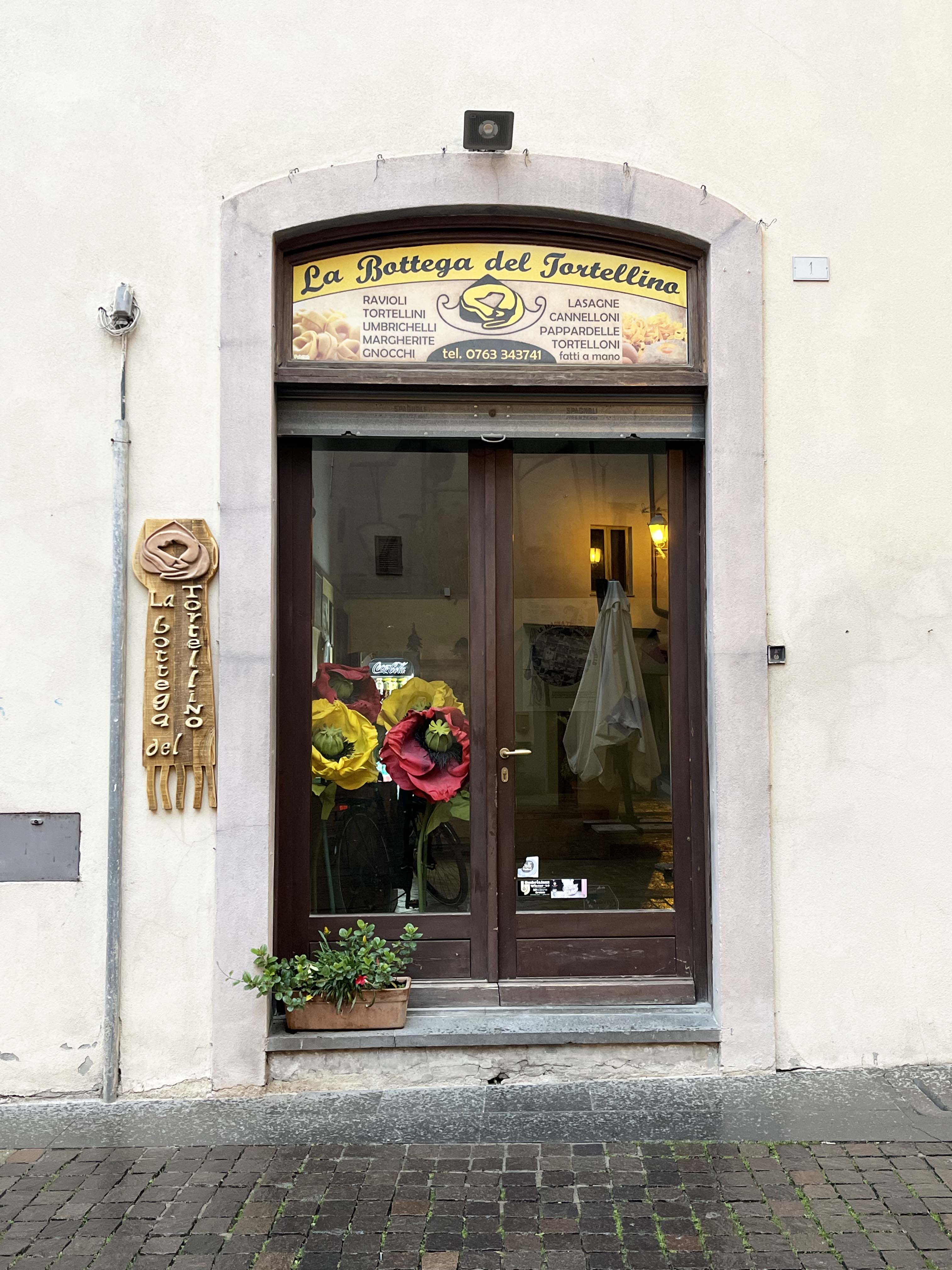
Trouble was ahead nevertheless, in the form of a sign on the main street with an arrow pointing to La Bottega del Tortellino, a pasta shop on a small square just off the main street of Corso Camillo Benso di Cavour, that enchanted, maybe bewitched us to come in. I never thought about the singular form of tortellini before, because who ever eats just one? They’re only ever served in the plural form.
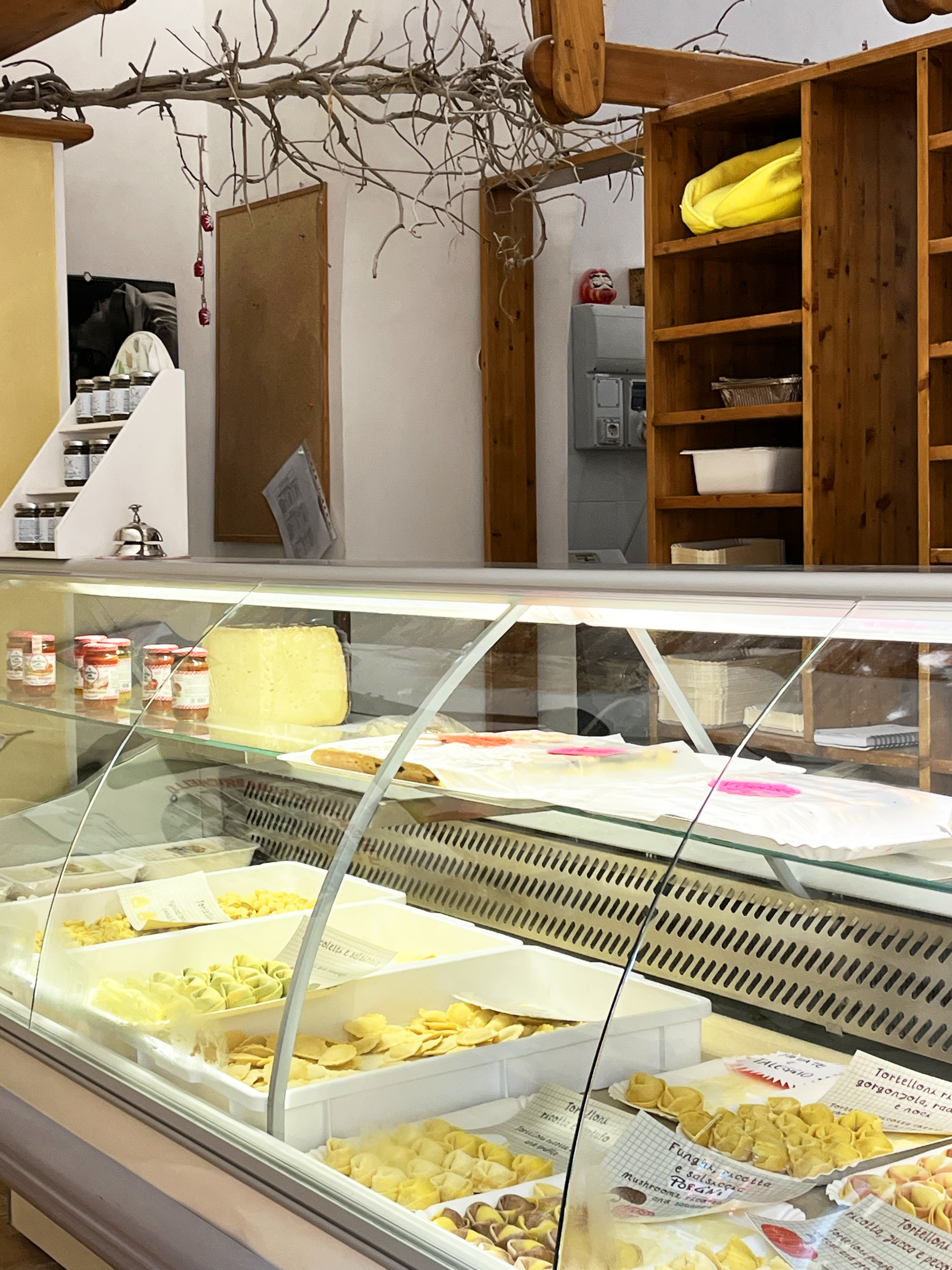
I stepped over the threshold and into the embodiment of my dream establishment, a storefront disproportionate in size relative to the larger space, the kitchen in back, where everything happens. A few antique tools used to cut the wheat, mill the flour and make the pasta hung on the walls painted, well, painted the color of pasta.
Pasta shops, in Italy, fall into the category of “I’m just looking, never going to buy”. Maybe “I’m here just for photos”. There was no reason to go into the shop other than to look. Gather ideas for what I might want to reproduce back home with my brother in his kitchen. Because although our room was “the best one in the hotel,” Maurizio told me, it didn’t have a kitchen to boil fresh made pasta.
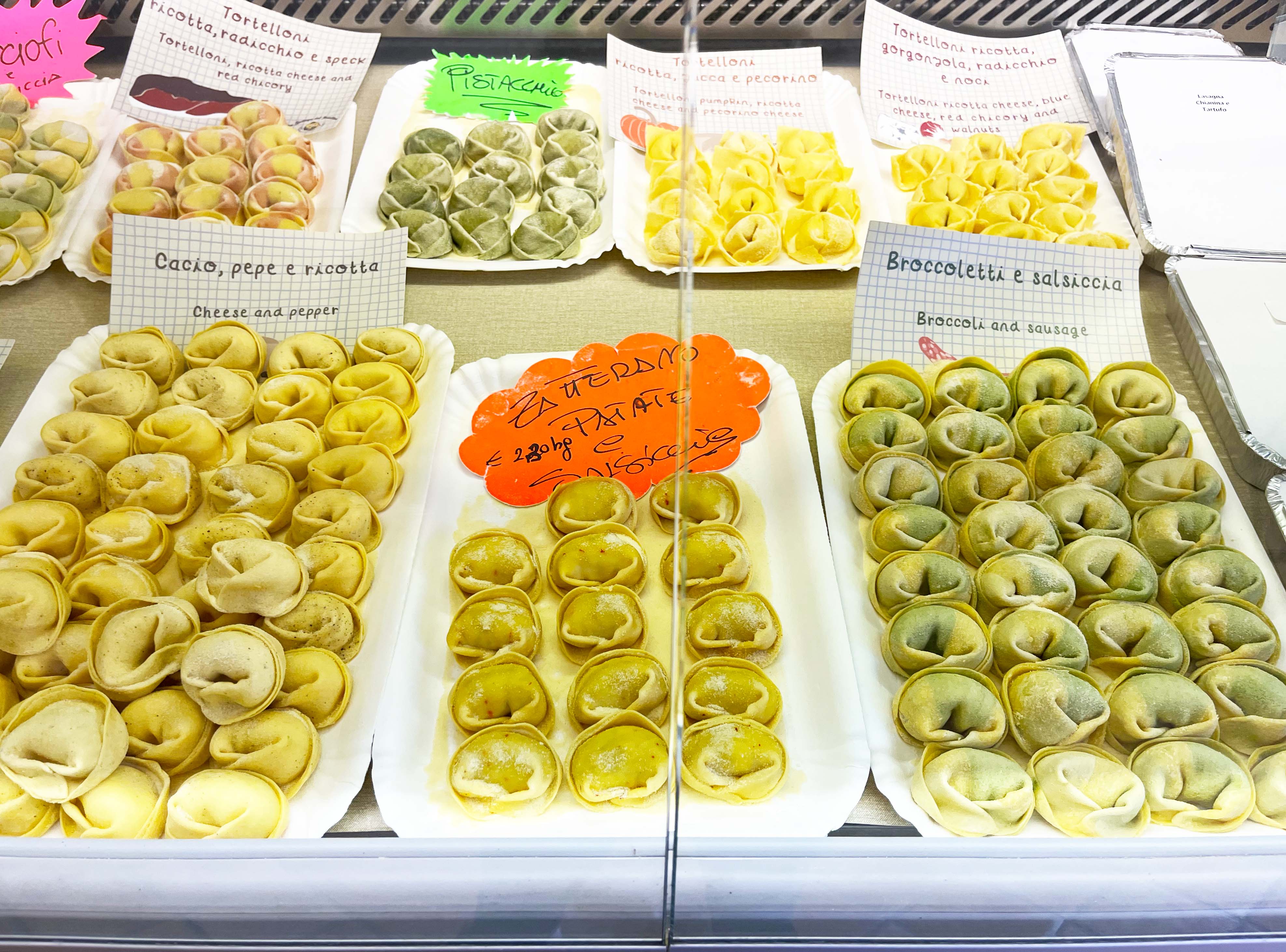
The shop was named for tortellini, but it was the tortelloni – an enlarged version of tortellini, about four times as big as a regular tortellino – that took up most of the show case.
Legend has it that tortellini were designed based on the belly button of the goddess of love, sex and beauty, Venus. Then tortelloni must represent an even grander homage to the love of the goddess of love. The tortelloni were lined up in rows, separated based on filling on rectangular shaped paper plates. Some were distinguished by colored pasta. The pistachio tortelloni were green. The radicchio tortelloni were half red.
Tortellini and tortelloni have important distinctions other than size. Importantly, what’s in them. Real tortellini just have a mixture of meat in them. Tortelloni on the other hand are more like gelati, too many flavors to choose from, with mixtures of ricotta with vegetables, nuts and meat. Tortelloni can also be served with different sauces, while the classic way to serve tortellini is in brodo, which is just a clear broth. Tortellini served with tomato sauce “is just for the tourists,” an Italian driver in Modena once told me.
The window on the outside for a view into the back of the shop had been blocked out with a wooden panel, obscuring the show of how the pasta is made. But I’ve watched before. Part of the process is performed by machine, but the last steps, the filling and the sealing of individual tortelloni, is still done by hand.
I always feel guilty walking into shops knowing from the outset that I’m not going to buy anything. Just looking, looking. Forcing the sales person to be friendly when you know it’s a charade, that you might be there just to steal a photo or a secret recipe. My guilt took over. I couldn’t pretend because no one else was in the shop at the moment.
“We can’t take any because we have nowhere to cook them,” I lamented in Italian.
And then the unexpected response, one I understood.
“We can cook them for you,” the woman behind the counter said.
“Here, right here, you can do that for us?” I asked, confirming what I thought I’d heard in Italian.
“Yes, and with a little olive oil and parmigiano. Or even tomato sauce.”
My mom was all in for that.
A portion was four or five tortelloni. We chose only four of the ten or so flavors, since my mother has more self-control than I do. I avoided the ones with pecorino as my mother does not like cheese made with sheep’s milk. That eliminated some of the other flavors, I guess making my job easier.
The woman behind the counter disappeared with our four tortelloni, and we sat on the bench positioned along the back wall while we waited. When she came back out, she asked if we wanted to eat them there. When I said yes, she pulled out a folded table hidden in a corner and set it up in front of us to eat at.
Now that’s customer service, I thought. Only the table cloth, the candle and the bottle of wine were missing. The giant paper flowers stood in a large clay pot in the window of the shop.
The woman listened to me in my stilted Italian. I wondered if she would have paid as much attention if I had spoken to her in English. I never would have found this place looking on the internet, and in another season, I’m guessing we wouldn’t have had a chance in that place. At least we never would have had the opportunity to choose between the many flavors they made.
If it was a good sign, locals filed in continuously, although never more than one or two at a time, to buy the products there. We were one step away from sitting at the chef’s table. The tortelloni were served to us right out of the pot, just as they should be eaten. Faded in color after boiling, the tortelloni arrived with olive oil and parimigiano in a round cardboard container to be eaten with wooden utensils. We cut each one in half, accurately, so as to be fair.
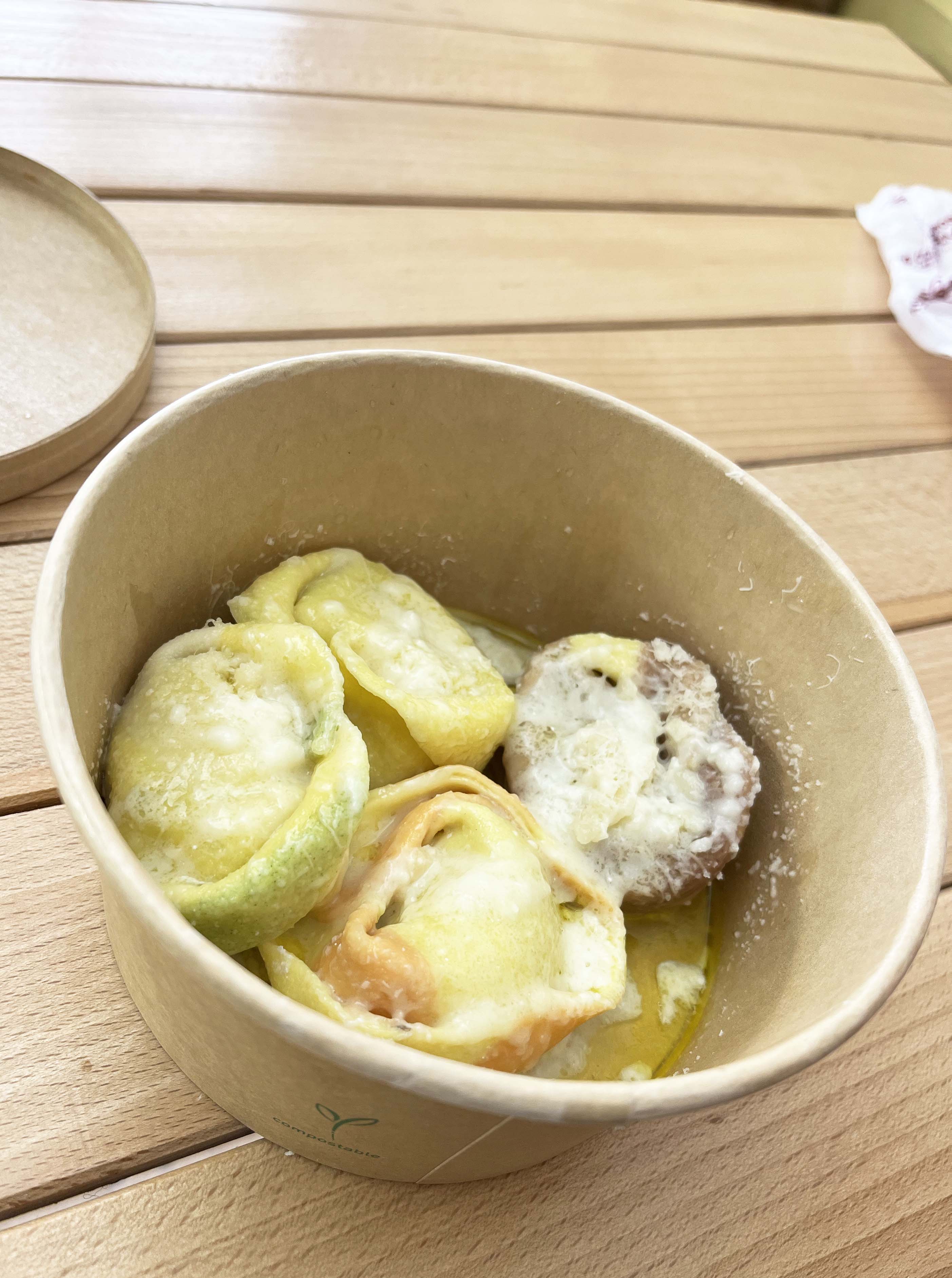
I’d argue it was one of the best meals we ate in Italy. Ricotta with carciofi and salsiccia was the favorite. We left, promising to return.
The next day, my mother asked to have them again for lunch. I obliged. I walked over to the shop, alone this time. A man was behind the counter. I told him I’d been there for lunch the day before, confirming that the shop cooked the tortelloni for customers. And that I was back for more.
“Yes, of course,” he said.
I chose four again, ones that were different from the day before.
“Poverino,” I heard. I’m not sure that’s the word he said. I think poverino is a thing not an adjective, but I understood, too little for two. Or it was wishful thinking on my part.
I took that as my permission to take more, to overrule my mother’s self-control, to taste them all this time. Ricotta with radicchio, carciofi, tartufi, porcini, pumpkin, pistacchio, and even walnuts. And my favorite combination for pasta, cacio e pepe.
After my tortelloni were taken to the back of the shop, the woman who waited on us the day before arrived.
“Sono ritornata!” I said. “I came back!”
She asked what I wanted, and I responded that I had already been helped.
When the tortelloni were ready, I handed over my 12 euros and raced back to the hotel, not too far, so they would still be warm for my mother. Her personal Door Dash delivery. Twice as many as the day before. She looked at me like I should never let you go out alone.
No matter how much you try to savor the dish in front of you, or how long it takes to make, it’s only a few minutes before it’s gone. Despite my mother’s protests of too many, within 15 minutes, the tortelloni were gone, and we were left scraping the remaining parmigiano out of the cardboard bowls with some bread from the bakery.
I always think my Italian is not that great. But then again, maybe it’s just good enough.
Books…
Norwegian Lessons in Indonesia (2023)
An Accidental Artist: Discovering Creativity through Scuba Diving (2018)
Art for sale at AnemoneWatch on Square
 Janice Nigro
Leave a comment