
When I started diving, I made a promise to myself to take a dive trip at least once a year. I did a pretty good job sticking with that philosophy for a couple of decades. Well, until the pandemic. Then any plans I had before the lockdowns were delayed and then delayed, and then delayed some more.
A bad case of lethargy had set in.
I knew I had it bad when I put off finalizing plans for the thing I liked to do more than anything else, diving in Indonesia. I simply didn’t want to take the trouble to travel. Sixty days to make a daily activity a habit? A couple of years of lockdown turned me off to travel. I had too much time to think about the stress of traveling with two suitcases full of equipment. Which parts I might leave home. Which parts might get damaged while diving. So I put off the hassle of committing to a dive trip for as long as everyone involved was OK with it.
Then Claudine, one of the owners of Abyss Ocean World in Pemuteran on Bali, plucked me out of my malaise – finally forcing me to apply the deposit I had sent to them a few years before for a trip that was supposed to take place in September of 2020. After so much time, I had almost convinced myself I would be happy to just leave the deposit as a donation to their small business creating memories for people for things they didn’t know they could even wish for.
Yes, Claudine forced me to go on a dive trip to North Sulawesi in Indonesia.
I’d been diving in North Sulawesi 10 years before, on my own, not with this group, not in French, and not at the resorts on the itinerary. But you can never dive a good site too many times. Like Nudi Falls in Lembeh, as one of my dive companions put it, “Everywhere you look, there is something to see.”

I agreed to the trip, Passport to Paradise, designed for diving from three different resorts in North Sulawesi: Murex Manado, Lembeh Resort, and Murex Bangka. The usual route is Murex Manado to Murex Bangka to Lembeh Resort. This route allows guests to dive while simultaneously being transported to the next destination by boat. My best travel day ever was diving while moving from Lembeh Resort to Murex Bangka.
I knew the diving in North Sulawesi would be great. I’d been there before. I didn’t have to read about it. And the diving wasn’t going to be difficult. The trip, I kept telling myself, would be a no-stress re-introduction to a sport that’s driven my solo travel around the world (and art) for many years. Lembeh Resort sits on Lembeh Strait which is famous for the unique, mostly benthic creatures that live in or above the fine black volcanic sand of the strait. There may be some current, but you’re never deep – 23 meters is the maximum depth and most of the dive takes place in less than 10 meters. And the water is warm. Sure, you’re still underwater with a tank of compressed air strapped to your back, and the potential of unhinged wildlife, like the blue-ringed octopus which delivers enough venom to kill several adults with a single bite. But I’ve never sustained any attack more serious than a sea urchin “tattoo” or a hydroid sting, and that’s when I put my fingers where they shouldn’t be.
Once I got over the anxiety of traveling again, I moved onto a new made-up anxiety, that I hadn’t been diving in over five years. This all changed the second I arrived at the resort in Manado (maybe after my first breath of tropical air after disembarking the plane) and started diving. I didn’t want to stop.
Our dive package covered about two dives a day, which at the outset seemed the right amount after such a hiatus from diving. I convinced myself a lighter dive schedule would allow more time for rest and other activities in the afternoons (naps), including some paying work and a photography class (at Lembeh Resort).
It wasn’t.
One way to pad your dive itinerary is to dive the house reef. The house reef is easy to overlook, although it doesn’t make sense (maybe I’m speaking for myself). The house reef is close (you walk or jump into it from the shore or a wharf), you only need a dive buddy, not a dive guide, and there’s no extra cost (with a dive package). Divers are always briefed on diving the house reef during the introduction presentation, and yet, I wouldn’t say I regularly partake in the opportunity. Maybe because my itineraries include a lot of diving. Or I dive from a liveaboard.
I haven’t ignored the house reef – they’re in my dive logs – I just forget to talk about them.
The irony is a house reef anywhere in Indonesia is a goldmine. You’re going to be on an island (it’s a country made up of over 17,000 of them), and in the Coral Triangle, the most marine biodiverse region on Earth. You’re not, not going to find critters, even in Lembeh Strait where it’s sand and midwater diving.
On a trip to Wakatobi in South Sulawesi, my dive buddy and I went out on our own at twilight one evening (because you can go when you want to go) to dive the house reef. It’s a wall, which is easy to follow, and the current decides whether you will go left or right. Life in a rainbow of colors branches out in all directions from the wall, but I remember this dive because of the painted lobsters. So many lobsters in their pastel palette were there, poking their antennae out of their cubbyholes, probing the environment nearby, as if they were stacked in studio apartments of a multi-story Gaudí designed condo for lobsters.
In Ambon, at Maluku Divers (which closed several years ago), we did our night dive on the house reef. We walked out, and in 10 meters or less, were treated to a parade of decorator crabs scurrying across the bottom while balancing tall sponges, grass, anemones and other random bits of sea life on their heads, shrimp, bobtail squid buried to their eyeballs, pleurobranchs, octopus, cuttlefish and mollusks leaving a trail behind in the sand. We dove for an hour and a half one evening, and only surfaced because we were hungry.
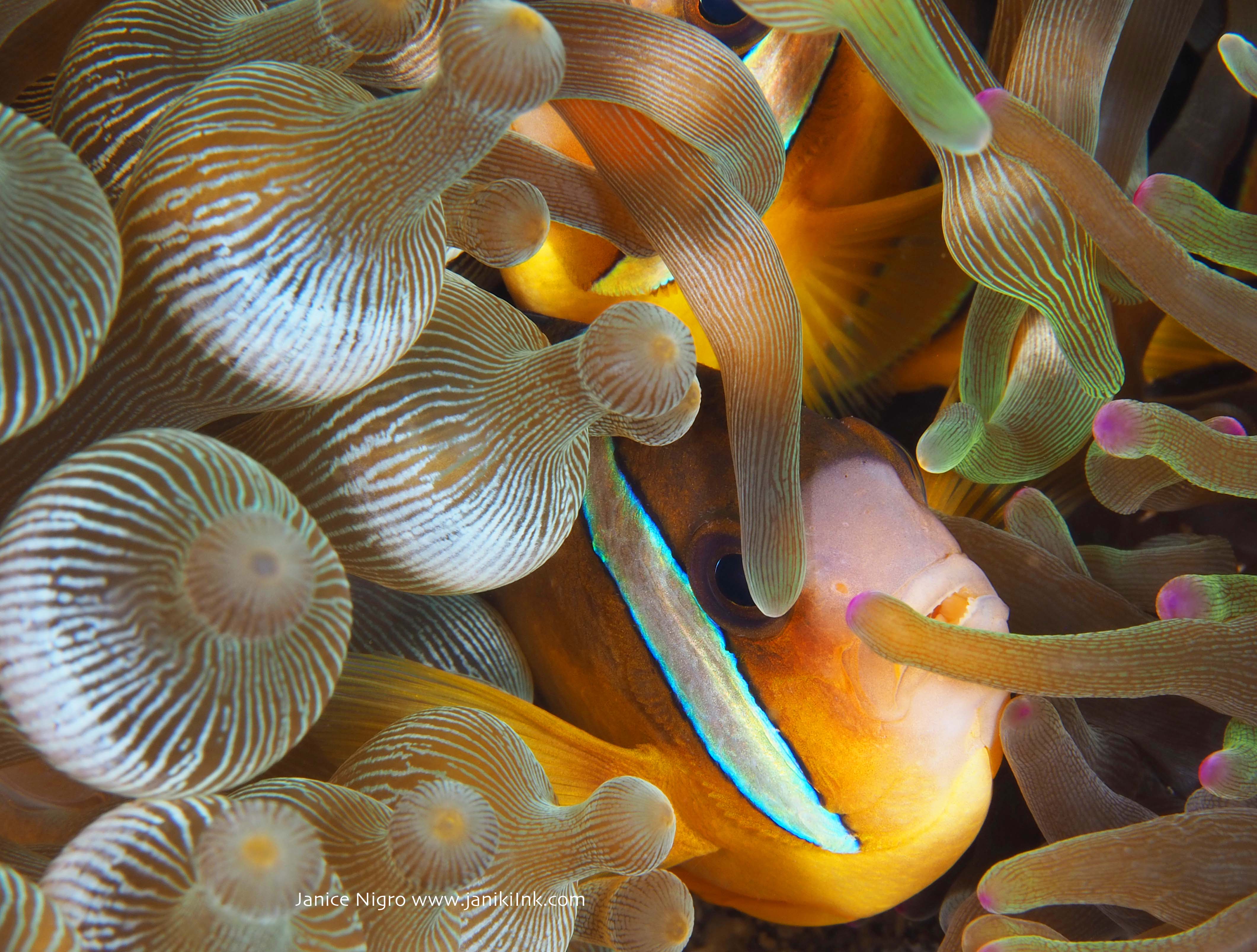
On a trip to Alor, the house reef was a Long John stride off the end of the pier. Just steps from our cottages, the world of Kalabahi Bay awaited us – octopus, xenocrabs, pipefish, mandarin fish, Harlequin crabs and of course, anemones!
The challenge underwater is to find critters, and without a guide on a house reef, you must do the work yourself. But on your own, you have the chance to test the tricks you’ve learned from the dive guide, the chance to sharpen your own “divey” senses. You’re set-up to succeed – a house reef dive is never that deep, and your air will last much longer at 10 meters than 20 meters. You have air and thus, time on your side.
I didn’t plan it this way – my first dive on my trip in March 2024 to North Sulawesi took place on a house reef. I arrived a day early, and since I hadn’t been diving in five years, I wanted a check-out dive to make sure my equipment worked (I did have it serviced before I left) and that I still knew how to use it. Sandro, one of the guides who would accompany us over our two week trip, took me diving on the house reef.
This is it how the dive went: strap my tank to my back (with help), walk into the water, put my fins on, swim out to a buoy and descend. Sandro is one of those dive guides with a magic finger – everywhere he points, there’s something to see. Lots of nudibranchs, some common ones (Phyllidias) and a Halgerda batangas, a white eye moray eel, a snake eel, a pair of dwarf fish, orangutan crabs, porcelain crabs, a hairy goby, a giant mantis shrimp, and an anemone the size of the palm of my hand with three clownfish in constant motion, trading places with each other in the limited space within it. An unfortunate moment to be without my camera.
At Lembeh, I was getting into the groove and started to feel like I wanted more time in the water. The main reason? To figure out how to use my camera. One free afternoon, I asked my dive guide Jefry if we could dive the house reef. Jefry said yes (although I don’t know whether he would ever say no).
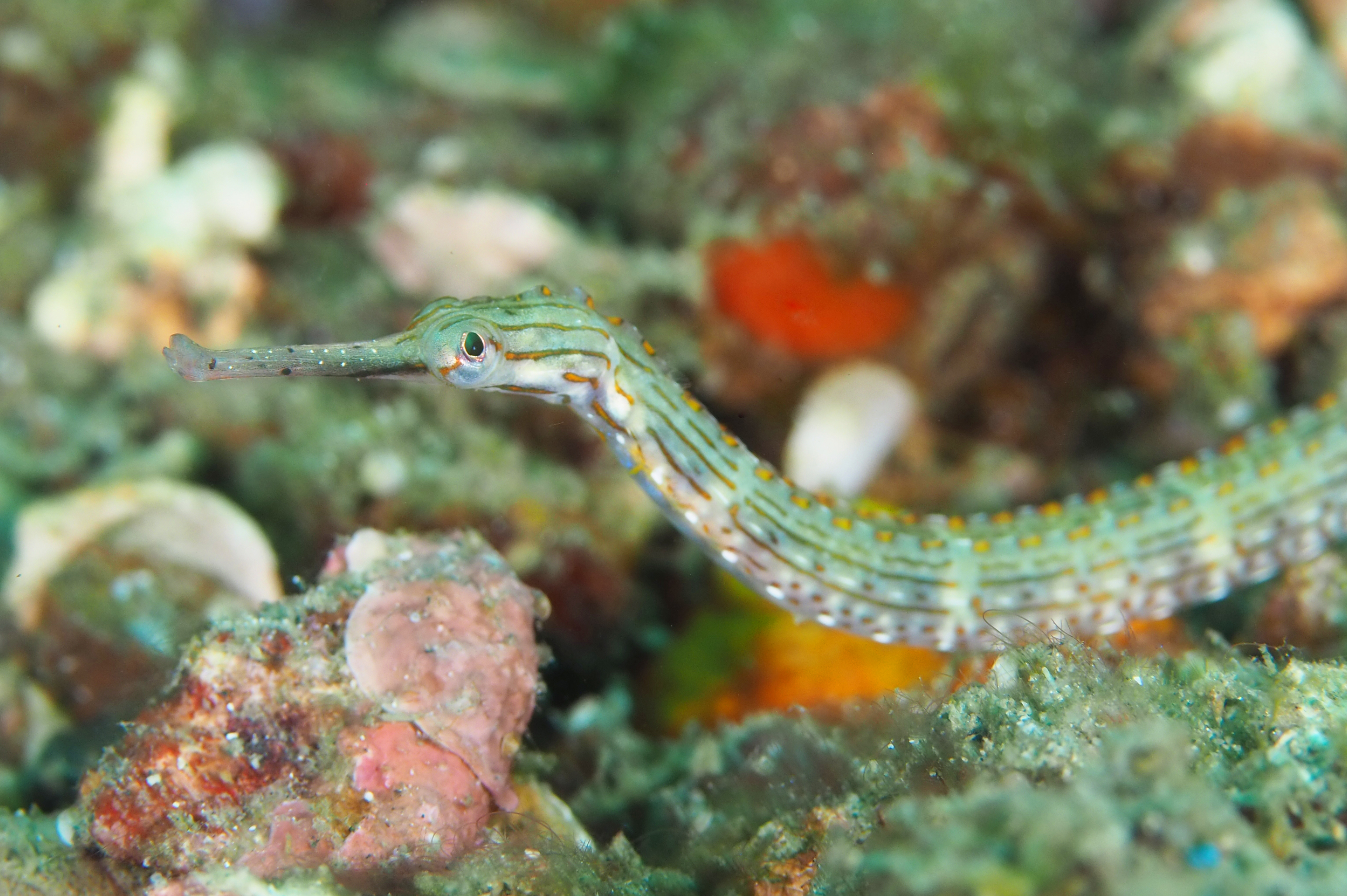
The Lembeh Resort house reef dive was another typical shore dive: swim out past the boats and descend. Nothing to it. A path through the house reef was staked out with posts to orient divers. Small bommies scattered about and a small artificial coral reef system supported the proliferation of marine life – a variety of nudibranchs, orange spotted pipefish, eggshell shrimp inside a mushroom coral, peacock shrimp, and a mantis shrimp.
But if I could call it a turning point in diving house reefs, it was the moment during the last few minutes of our dive, when a teenager-sized (maybe it was a male as they are much smaller than females) frogfish jetted along the sandy bottom into our view.
“I didn’t expect to find a frogfish there!” Jefry said after we surfaced.
The frogfish bouncing from side to side surprised even Jefry. Yup, we were just 10 meters from the shore and 3 meters under water. The site isn’t color dense. If anything, there’s not much color at all. But that’s Lembeh Strait – the fine volcanic sand remains suspended in the strait, like a permanent underwater haboob.
That little guy, that teenager frogfish strutting into our dive, made me think the other divers were missing out.
Our last full day of the trip on Bangka Island was reserved for doing, well, nothing. A day without diving is scheduled for degassing (nitrogen) for at least 24 hours before flying. But one dive (even a couple of dives) on the morning of the last day would still have left me with a greater than 24-hour window before my flight out the next day.
“Let’s dive the house reef,” Jefry said. “We can just look at anemones.”
The magic words, “We can just look at anemones.”
He had gotten to know me, a little bit over the two weeks.
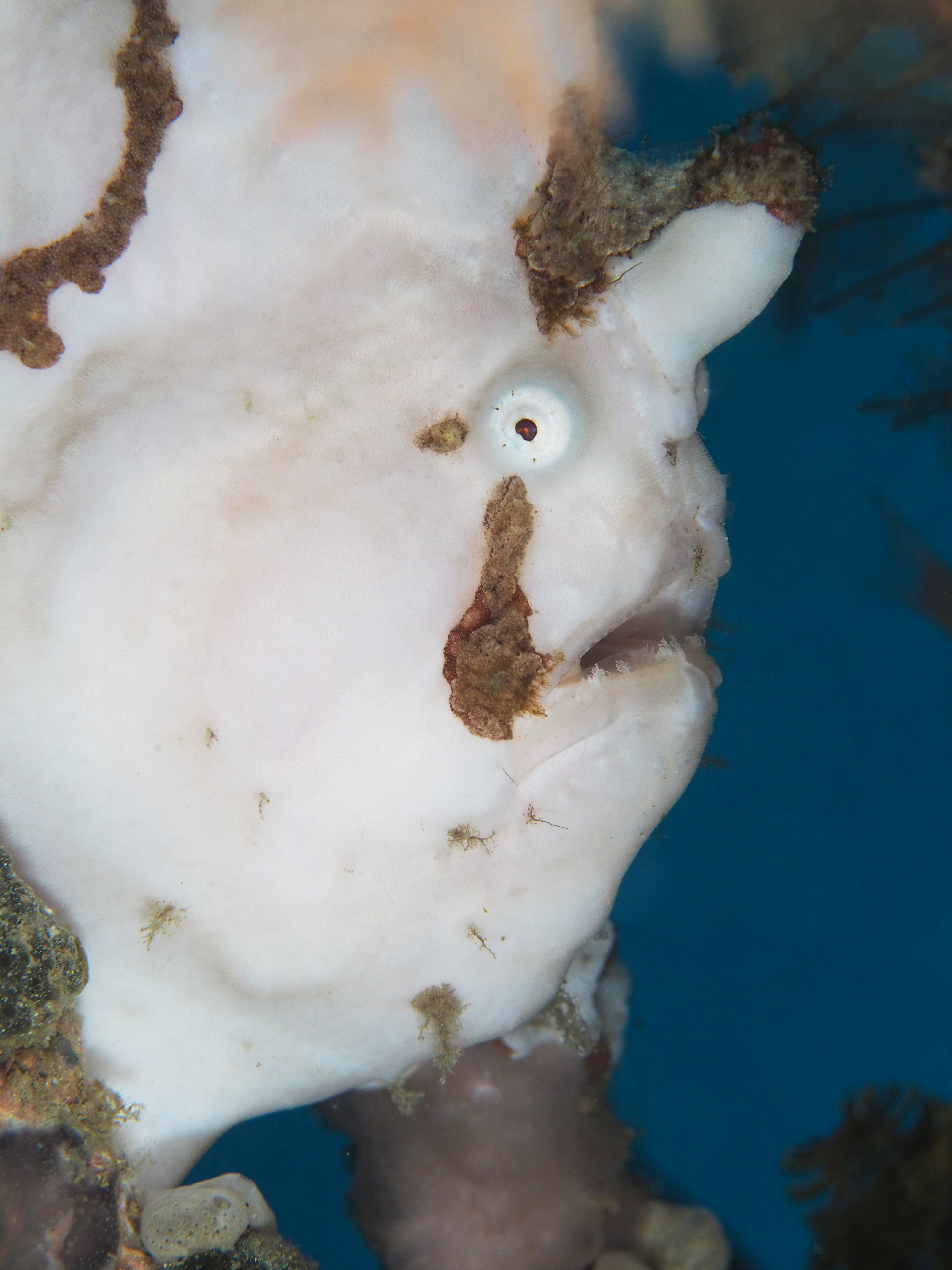
I suspected the house reef at Murex Bangka would be great. The afternoon dive the day before at a site called Demak dazzled. Some thought it was the best dive of the trip. Just a few meters beyond the pier at the resort next door, the main attraction at Demak is a pinnacle you could spend circling for the entire hour of the dive. Even a school of blue-striped yellow snapper did that. A giant white frogfish anchored itself there upside down – a fish can do that underwater – among the barrage of soft corals, sponges and tunicates. Nudibranchs creeped along the walls and isolated on the sandy bottom. And Jefry continued to impress me until the last moments of the dive again, exposing a yellow Pontohi pygmy seahorse, one centimeter in size, in his otherwise nondescript algal habitat.
I didn’t think Jefry was paying much attention to me on the last dive. I was just photographing anemones and anemonefish (trying anyway), while he was looking for macroscopic surprises that you don’t even know to look for. But he did care. When he pointed to his slate, he had written down a suggestion for capturing the anemonefish, “Act like a hard coral.”
I surfaced with a half a tank of air at 77 minutes and a maximum depth of 9.4 meters. I could have stayed longer, but Jefry had to catch the boat for the 30-minute ride across the sea to the main island where he lived with his wife and child.
My party was over. His would start again in the next week with new guests.
In the afternoon after the dive, when I had time to go over my images from that last dive, I realized something else. The flash setting on my camera was wrong. The previous 23 dives hadn’t been enough to penetrate my brain that I wasn’t getting proper light on my subjects. I sensed it. I just didn’t know why. I considered the usual factors – strobe or fiber optic cable malfunction. Neither of those parts ended up being the source of the problem.
I can’t know for sure if I needed the last dive on the house reef to trigger the resolution for my problems with my underwater rig – all I know is I figured out the problem after that last dive.
So don’t knock diving the house reef.
Books…
Norwegian Lessons in Indonesia (2023)
An Accidental Artist: Discovering Creativity through Scuba Diving (2018)
Art for sale at AnemoneWatch on Square
 Janice Nigro
Leave a comment